Rolwaling Valley Trek
Overview
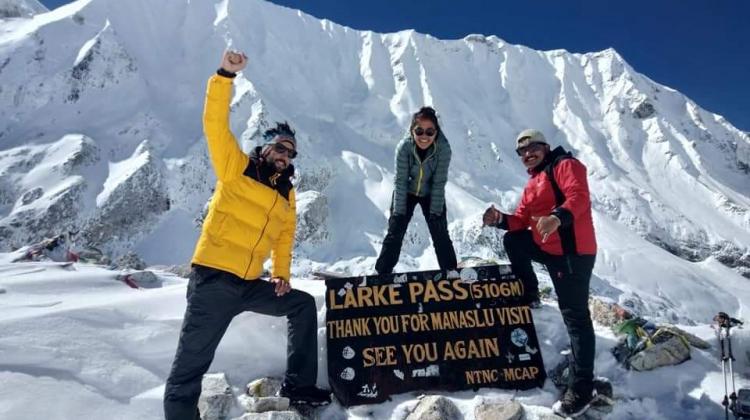
The Rolwaling Valley Trek takes you through remote and challenging high-altitude terrain, beginning in Kathmandu, continuing into the Rolwaling Valley, crossing the famous Tashi Lapcha Pass (5,755 m), and eventually reaching the Khumbu Region. After a scenic drive to Dolakha and onward travel toward the Rolwaling region, the trekking route gradually enters the remote mountains of Rolwaling Valley.
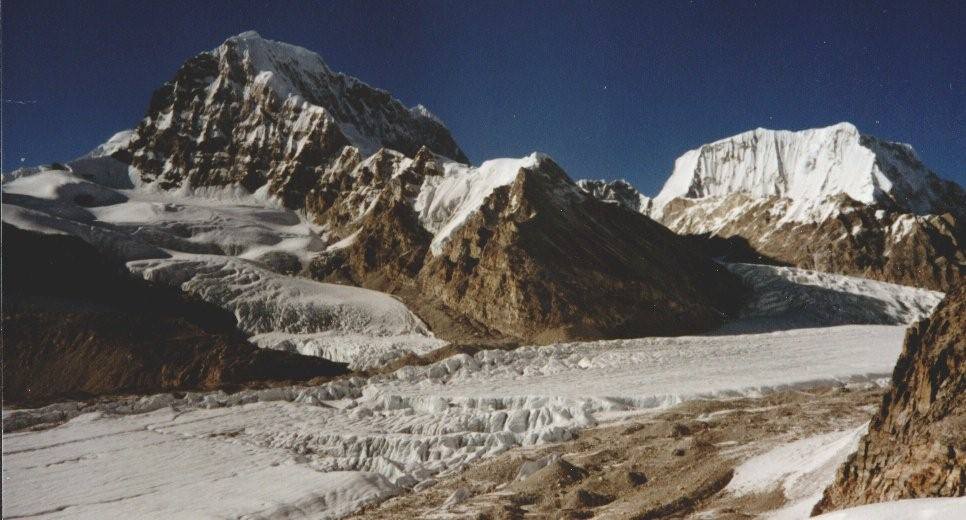
Trekking in Simigaon, Beding and Na Gaon will take you through the traditional mountain villages and valleys along with some forested areas and rugged alpine regions. The acclimatization day in Na Gaon allows you to adjust to the altitude before continuing toward the higher and more challenging sections of the trek. The route then continues toward Nyiduk Kongma and Drolumbau Glacier before reaching Tashi Lapcha Pass, the highest and most challenging point of the trek.
Later on, the descent starts towards Thame and moves ahead towards the Khumbu Region until reaching Namche Bazaar and Lukla.
Trekking in Simigaon, Beding and Na Gaon will take you through the traditional mountain villages and valleys along with some forested areas and rugged alpine regions. The acclimatization day in Na Gaon allows you to adjust to the altitude before continuing toward the higher and more challenging sections of the trek. The route then continues toward Nyiduk Kongma and Drolumbau Glacier before reaching Tashi Lapcha Pass, the highest and most challenging point of the trek.
Later on, the descent starts towards Thame and moves ahead towards the Khumbu Region until reaching Namche Bazaar and Lukla.
What to Expect on the Rolwaling Valley Trek – 19 Days
The 19-day Rolwaling Valley Trek is a difficult high-altitude adventure in which you start your expedition from Kathmandu by going to the isolated Rolwaling Valley and then cross the magnificent Tashi Lapcha Pass of 5,755 meters in altitude and move on to the Khumbu region. In this trek, you will walk on long trails, visit traditional villages, enjoy spectacular valleys, see glaciers and explore alpine terrain. First, you will gradually climb to Simigaon, Donga, Beding and Na Gaon and then have an acclimatization day at 4,180 meters of altitude. Then, you move into the more challenging glacial terrain around Nyiduk Kongma and Drolumbau Glacier before crossing Tashi Lapcha Pass and descending toward Thame and Namche Bazaar.
- Experience the remote and untouched landscapes of Rolwaling Valley.
- Cross the spectacular Tashi Lapcha Pass at 5,755 meters, the highest point of the trek.
- Trek in the traditional mountain areas like Simigaon, Beding, Na Gaon and Thame.
- Explore the impressive scenery of Drolumbau Glacier and other high-altitude mountains.
- Have an acclimatization day in Na Gaon before starting the upper parts of the trek.
- Experience the diverse landscapes of green forest and river valleys, alpine terrain, glaciers and snow-covered peaks.
- Explore the traditional Sherpa culture and mountain way of life of Rolwaling Valley.
- Visit Thame, the historical Sherpa village famous for its mountaineering traditions.
- Explore the village of Namche Bazaar, the main trading and trekking center of the Khumbu region.
- Enjoy the amazing scenery of flying from Lukla to Kathmandu.
- Enjoy the remote mountain trails where you find fewer trekkers than other Nepalese trekking trails.
- Enjoy the spectacular scenery of the Himalayan peaks, valleys, glaciers and high altitude landscapes.
- Experience the difficulty of high-altitude trekking, glacial areas, and crossing the Tashi Lapcha Pass.
- Stay overnight in mountain villages and experience the hospitality of local communities.
- Explore both the cultural and adventure parts of the Himalayas during 19 days.
Extra Highlights of the Rolwaling Valley Trek – 19 Days
In addition to the Tashi Lapcha Pass Crossing, there are many other highlights on the Rolwaling Valley Trek, which takes place over a course of 19 days. The path goes from the cultural and historical environment of Kathmandu to the remote mountain valleys, traditional settlements, high-altitude wilderness areas, and the Khumbu region in particular. This diversity of the scenery and remote environment makes this trek especially interesting to those who have previous experience of mountain walking and seek something more adventurous than popular Nepal trekking tours.
- Visit the cultural and historical sights of Kathmandu Valley before starting the trek.
- Get to Dolakha via a scenic drive from Kathmandu across the hills of Nepal.
- Head to the remote Rolwaling Valley via the route following the Tama Koshi River.
- See the traditional settlements and the lifestyle of mountain people.
- Cross the suspension bridges, rivers, and mountain trails on the way to the upper Rolwaling Valley.
- Notice the changes in the landscape as the route rises from forested valleys to the alpine zone.
- Discover Beding, the most significant village in the Rolwaling Valley and a traditional Sherpa community.
- Stay in Na Gaon and feel the atmosphere of a remote high-altitude mountain village.
- Take an acclimatization day in Na Gaon for exploring the surroundings.
- Trek through the increasingly barren and harsh land area of Nyiduk Kongma.
- Visit the remote Drolumbau Glacier at about 5,200 meters.
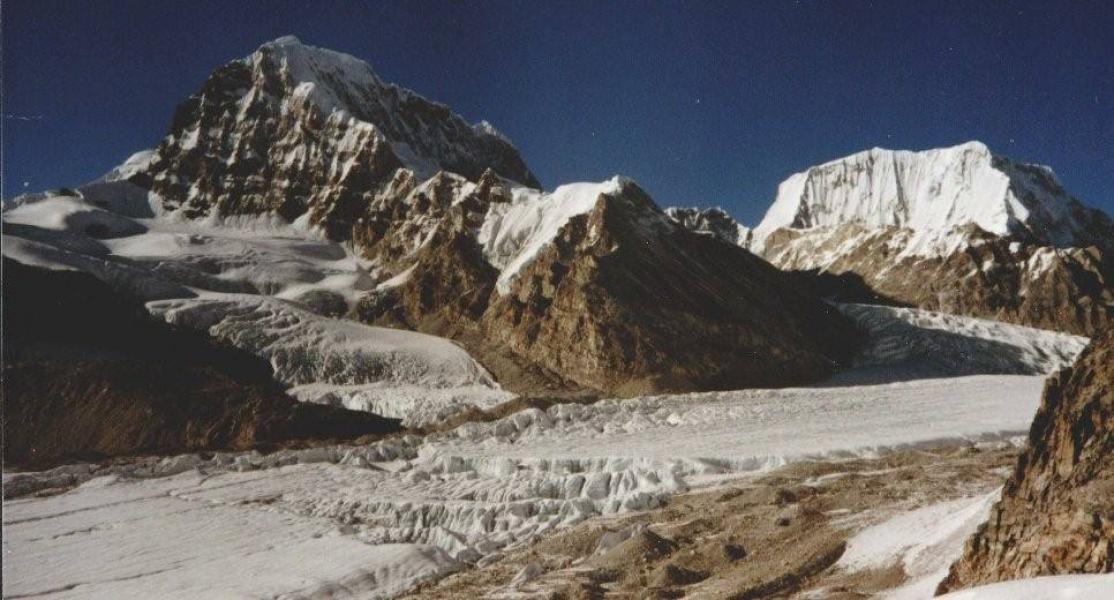
- Experience snow, ice, rocks, glaciers, and high mountains on your way to Tashi Lapcha Pass.
- Trek through one of the toughest sections of the trip through Tashi Lapcha Pass.
- Admire the amazing views of glaciers, Himalayas, and mountain valleys from the pass.
- Get down to the greener area of Thame from the high glacial area.
- Tour Thame and know about the traditional Sherpa heritage and their link to mountaineering in the Himalayas.
- Trek further towards Namche Bazaar in the Khumbu region post pass.
- Experience the vibrant environment of Namche Bazaar after being in the remote mountain villages for some days.
- Notice the change in the landscape during your trek down to Lukla.
- Enjoy a beautiful flight back to Kathmandu from Lukla.
Best Time for the Rolwaling Valley Trek
Because the route reaches 5,755 meters and includes glaciated terrain around Drolumbau Glacier and Tashi Lapcha Pass, choosing the right season is especially important. But considering the fact that this path has an altitude of 5,755 meters at Tashi Lapcha Pass and involves glaciated terrain near the Drolumbau Glacier, the weather conditions are extremely important for the trip. Spring (March to May) and autumn (September to November) are generally considered the most favorable seasons for high-altitude trekking in Nepal because of relatively stable weather and better mountain visibility.
- Spring (March-May): This period is considered favorable for trekking in terms of improved weather and visibility. Valleys below get green, and the higher elevations remain encircled with snowy peaks of the Himalayas. You should still assess the conditions near the Tashi Lapcha Pass carefully before the start of the trip.
- Autumn (September-November): Autumn is generally considered one of the best seasons for trekking in Nepal. Usually, the monsoon clears the atmosphere and gives better visibility of the mountains. The trails and landscapes at the high altitudes of Rolwaling and Khumbu are especially spectacular during this season.
- Winter (December-February): This time of year is characterized by very low temperatures and high probabilities of snow and ice on the higher elevations. Conditions near the Drolumbau Glacier and the Tashi Lapcha Pass become especially hard, and you should have enough equipment and experience at high altitudes.
- Monsoon (June-August): Monsoon brings rains to the lower part of the itinerary and makes the trails and roads wet and slippery. Cloudy skies can reduce the visibility of the mountain range. Due to the fact that the itinerary starts with the trip by road through the hills before reaching the mountains, weather conditions should be taken into account.
Trek Accommodation and Meals on the Rolwaling Valley Trek – 19 Days
The 19-day Rolwaling Valley Trek combines hotel accommodation in Kathmandu with basic teahouses, mountain lodges, and trekking camps in the remote Rolwaling and Khumbu regions. As you move toward higher and more isolated areas, facilities become simpler. Meals are available at teahouses and mountain lodges along the main trekking route, while food options in areas such as Nyiduk Kongma, Drolumbau Glacier, and around Tashi Lapcha Pass depend on seasonal and local conditions.
- Stay in a standard hotel in Kathmandu on Days 1, 2, 17, and 18.
- Stay in local teahouses or mountain lodges where available, with camping or designated overnight arrangements required in the more remote sections near Drolumbau Glacier and Tashi Lapcha Pass.
- Stay in twin-sharing rooms with basic bathroom facilities where available.
- Expect increasingly basic accommodation as you move deeper into the remote and high-altitude sections of the Rolwaling Valley.
- Stay in designated overnight camps or other arrangements around Nyiduk Kongma and Drolumbau Glacier, depending on trail conditions and the trekking team's arrangements.
- Accommodation around Tashi Lapcha Pass is arranged by the trekking team according to weather, trail conditions, and operational requirements.
- Enjoy meals at teahouses and mountain lodges along the trekking route.
- Breakfast options generally include porridge, eggs, bread, pancakes, Tibetan bread, muesli, and hot drinks.
- Lunch and dinner may include dal bhat, noodles, fried rice, pasta, soup, potatoes, vegetables, and other locally available dishes.
- Try Nepali dal bhat, a popular and filling meal among trekkers.
- Enjoy hot drinks such as tea, coffee, ginger tea, lemon tea, and hot chocolate at lower and mid-altitude areas.
- Vegetarian meals are generally available at teahouses along the trekking route.
- Expect fewer food choices in remote and high-altitude areas because transporting supplies is more difficult.
- Carry reusable water bottles and purify drinking water using purification tablets, drops, or a suitable water filter.
Cultural Experiences During the Rolwaling Valley Trek – 19 Days
The Rolwaling Valley Trek combines mountain adventure with opportunities to experience the traditional culture of remote Himalayan communities. As the route moves through Rolwaling and into the Khumbu region, you can observe traditional settlements, Buddhist practices, mountain architecture, and the way local communities have adapted to life in the high Himalayas.
- Explore traditional settlements such as Simigaon, Beding, Na Gaon, Thame, and Namche Bazaar.
- Learn about the traditional lifestyle of communities living in the remote Rolwaling Valley.
- Discover Sherpa culture and traditions shaped by life in the high Himalayas.
- Observe traditional mountain houses, stone buildings, agricultural areas, and settlements along the trail.
- See Buddhist cultural features such as prayer flags, mani walls, chortens, prayer wheels, and other religious structures.
- Experience the peaceful and isolated atmosphere of the Rolwaling Valley.
- Learn about traditional livelihoods, including tourism, agriculture, livestock raising, and yak herding.
- Spend time in Beding and Na Gaon, important settlements in the upper Rolwaling Valley.
- Visit Thame, a historic Sherpa village in the Khumbu region with a strong connection to Himalayan mountaineering.
- Explore Namche Bazaar, an important trading and trekking center in the Khumbu region.
- Observe how traditional Himalayan culture continues alongside tourism and mountaineering.
- Experience the hospitality of local people and mountain communities.
- Learn about the importance of mountains, valleys, glaciers, and the natural environment to local communities.
- Experience the contrast between the remote cultural landscape of Rolwaling and the busier trekking environment around Namche Bazaar.
- Respect local customs and Buddhist traditions when visiting villages, religious structures, monasteries, and other culturally significant places.
Trekking Difficulty of the Rolwaling Valley Trek – 19 Days
The 19-day Rolwaling Valley Trek via Tashi Lapcha Pass is a strenuous and challenging high-altitude trek. It is considerably more demanding than a standard teahouse trek like Annapurna Base Camp or Poon Hill Trek because the route passes through remote terrain, reaches 5,755 meters, and includes the crossing of Tashi Lapcha Pass. The trek involves long walking days, steep ascents and descents, rough terrain, and potentially snowy or icy sections. Previous experience with high-altitude trekking and good physical fitness are strongly recommended.
- The trek is best suited to physically fit trekkers with previous experience in demanding mountain hiking.
- Expect approximately 5 to 8 hours of trekking per day, depending on terrain, weather, trail conditions, and walking pace.
- Cross Tashi Lapcha Pass at 5,755 meters, the highest point of the trek.
- Take extra care in high-altitude sections around Nyiduk Kongma, the Drolumbau Glacier, and Tashi Lapcha Pass.
- Prepare for steep climbs, rocky trails, rough terrain, glaciers, snow, and ice.
- Pay particular attention to altitude after reaching 4,000 meters.
- Use the acclimatization day at Na Gaon to allow your body to adjust before ascending further.
- Maintain a slow and steady pace, especially above 5,000 meters.
- Follow your guide's instructions carefully when crossing glacial and high-altitude sections.
- Depending on seasonal conditions, additional equipment such as microspikes, crampons, ropes, or other technical gear may be required around Tashi Lapcha Pass.
- Be prepared for changes to the route if weather or trail conditions become unfavorable.
- Prepare physically several weeks before the trek through hiking, walking, stair climbing, running, cycling, or other aerobic exercises.
- Build your leg strength and endurance before starting the trek.
- Stay well hydrated and eat regularly throughout the journey.
- Inform your guide immediately if you experience headache, dizziness, nausea, unusual fatigue, or breathing difficulties.
- Take the remoteness of the Rolwaling Valley and the demanding Tashi Lapcha Pass crossing seriously.
Why Trek with Nepalaya Treks?
Choosing an experienced trekking company is important for a demanding journey such as the Rolwaling Valley Trek via Tashi Lapcha Pass. Nepalaya Treks Adventure manages key aspects of the journey, including logistics, trekking guides and porters, accommodation, transportation, and support throughout the high-altitude sections. The company supports your journey from Kathmandu through the remote Rolwaling Valley and across Tashi Lapcha Pass before your return to Kathmandu from Lukla.
- Trek with experienced and certified guides who are familiar with the Rolwaling and Khumbu region.
- Enjoy the assistance of experienced trekking guides and porters throughout the journey.
- Accommodation at hotels, teahouses, and other relevant accommodation facilities along the route.
- Leave all main logistics to the trekking company – permits, transportation, accommodation and trekking arrangements.
- Get the guide's assistance while going through the difficult part of the route – Drolumbau Glacier and Tashi Lapcha Pass.
- Use trekking equipment such as a sleeping bag, down jacket, and duffel bag if these items are included in your trekking package.
- Your condition will be observed by the experienced guides while gaining altitude.
- Get recommendations concerning pacing, hydrating, rest, acclimatizing and changes in the mountain weather.
- Get assistance in the preparation of equipment and additional equipment which is needed for high-altitude trekking.
- Get assistance prior to and during the trip regarding any questions, preparations, or emergency situations.
Why Choose This Itinerary?
Rolwaling Valley Trek for 19 days through Tashi Lapcha Pass is designed for those tourists who would like to explore the more isolated regions of the Himalayan mountains of Nepal. The tour includes travel through remote mountain villages, high altitude, glaciers, crossing Tashi Lapcha Pass, and staying at Sherpa settlements in the Khumbu region.
- Travel through the remote and off-the-beaten-track Rolwaling Valley.
- Cross the Tashi Lapcha Pass that has an elevation of 5,755 meters, which is the highest elevation of the trek.
- Explore the landscape of Drolumbau Glacier.
- Visit traditional villages like Simigaon, Beding, Na Gaon, and Thame.
- Stay one day for acclimatization at Na Gaon before moving to the upper part of the trail.
- Have an experience with varying landscapes from forested valleys and villages to rocky areas and glaciers.
- Visit high altitude area not included in the popular trekking routes of Nepal.
- Experience traditional Sherpa culture and lifestyle in the Rolwaling and Khumbu regions.
- Visit the historical Sherpa settlement of Thame associated with Himalayan mountaineering.
- Get to Namche Bazaar, one of the most important trading and trekking centers in the region of Mount Everest.
- Take a scenic flight from Lukla to Kathmandu at the end of your trekking adventure.
- Experience a mixture of culture discovery, remoteness, glacier trekking and high-altitude adventure.
- Experience a longer tour program allowing enough time to get to altitude before crossing the Tashi Lapcha Pass.
Responsible Tourism
Nepalaya Treks Adventure understands that responsible travel is of high significance while organizing tours in remote mountain villages in the Himalayas. Rolwaling Valley and Khumbu Region have fragile mountain environments and culturally important communities. Moreover, trekkers must respect local culture and traditions and be conscious about wastage and environmental conservation during the trek.
- Show some respect for the culture, traditions, and religion of the local mountain community.
- Ask for permission before photographing local people, particularly during personal, religious, or cultural activities.
- Have some respect for monasteries, chortens, mani walls, prayer wheels, and other religious places. Carry water in reusable water bottles and not plastic water bottles.
- Filter your drinking water with purification tablets or a water filter.
- Do not leave plastic, food packaging, tissues or any other rubbish on the way.
- Walk only on the trails to help avoid damaging the environment and minimize erosion.
- Do not disturb wild animals or damage vegetation.
- Consume water and electricity rationally in remote mountain villages.
- Support local communities by staying at local teahouses and lodges and purchasing locally available goods and services.
Group Size
The Rolwaling Valley Trek can be arranged for solo travelers, couples, families, groups of friends, and private groups. As the trek passes through remote areas and includes a challenging high-altitude pass, the group size and arrangements can be tailored to your travel preferences and experience. Trek on a scheduled date or arrange the trek on your preferred travel dates. Plan the trek for solo travelers, couples, families, friends' groups, or a private group. Get a more personalized experience on the trails with smaller groups and a personal guide. Go at an easier pace considering your group’s abilities. Stop in between for rest, hydration, photographs, and acclimatization.
- Be well-guided while walking on difficult trails of the trek. You can have a licensed guide, experienced porters, and other trekking support for a larger group.
- An assistant guide can be provided for a large group depending on the size of the group and requirements.
- Organize the trek on your preferred travel dates and requirements.
- Be flexible yet get assistance from professionals throughout the trek.
- Private Departure Available
- Those who wish for a more personalized experience can opt for a private departure on the 19-day Rolwaling Valley Trek via Tashi Lapcha Pass.
- You can trek with your family, friends, spouse, or even on your own, having your own team for the trek rather than joining a group.
- A private trek gives you greater flexibility while following the established Rolwaling and Tashi Lapcha Pass route.
- Ideal for lone trekkers, couples, families, corporate teams, or private groups who want a tailor-made experience in the Himalayan ranges.
- You may plan your departure date according to your travel convenience. Be flexible regarding the speed of trekking, photography, and visiting.
- Discuss your physical condition and trekking requirements with your guide or trekking company before departure.
- More customized information can be gained from the trekking guide.
Equipment Rental Information
In case you don’t have all the equipment needed for the trek, most of the trekking equipment is available for hire in Kathmandu before your departure. Hiring equipment can lower your expenses and enable you to carry less luggage during the trek. Nepalaya Treks Adventure can help with equipment arrangements, while various trekking stores in Kathmandu provide equipment for hire.
- Hire the following basic equipment: sleeping bags, down jackets, trekking poles, and duffel bags, depending on the package you book.
- Hire other additional equipment: backpacks, trekking boots, gaiters, microspikes, and other trekking accessories.
- Use traction equipment when it’s icy and/or snowy in higher portions of the trail.
- Extra equipment will be required for the Tashi Lapcha Pass depending on the existing conditions of snow, ice and trail.
- Ensure that all equipment you hire is the right size and in good condition before setting out for the trek.
- Ensure that the hired equipment is clean, in good condition and appropriate for high altitude environment.
- Take along personal clothes and toiletries like thermal wear, gloves, trekking socks, base layers and personal hygiene items.
- It is important to wear comfortable and well-fitted trekking shoes in order to reduce blisters.
- Carry light equipment and not unnecessary equipment.
- Microspikes might be needed on icy or snowy trails.
- Technical equipment may be necessary for the Tashi Lapcha Pass depending on seasonal conditions and the route selected by the trekking team.
Trip Highlights
- Combine cultural experiences with a challenging high-altitude adventure over 19 days.
- Explore the less popular route in comparison with other trekking routes in Nepal.
- Take a scenic flight from Lukla to Kathmandu, enjoying aerial views of the Himalayan landscape along the way
- Go through Namche Bazaar – the famous trading center of the Khumbu region.
- See Thame – the historical Sherpa village with a rich mountaineering tradition.
- Marvel at the changing landscape from the lush valleys and forests to the arid alpine landscape, glaciers and snow-covered peaks.
- Take a rest at Na Gaon (4,180 m) during the acclimatization day.
- Marvel at the amazing Himalayan views in both Rolwaling and Khumbu regions.
- Trek to the traditional Sherpa villages such as Simigaon, Beding, Na Gaon and Thame.
- See the Drolumbau Glacier and the wonderful glacial landscape.
- Get acquainted with the remote Rolwaling Valley – one of the most secluded areas for Himalayan trekking in Nepal.
- Cross the Tashi Lapcha Pass that is 5,755 m high – the highest and the most difficult part of the trekking.
Itinerary
Day 1: Arrival at Kathmandu Airport
Your journey begins when you arrive at Tribhuvan International Airport in Kathmandu. A representative will meet you at the airport and transfer you to your hotel in Kathmandu. During the drive, you can get your first glimpse of Nepal through Kathmandu’s busy streets, traditional architecture, colorful shops, and surrounding hills.
This gives you an opportunity to meet your trekking team and prepare for the demanding journey ahead. Your guide and trekking team will help you prepare for the journey and make sure you have everything you need for the trek. Also, you will be provided with all the information you need about your trek, such as the route, walking hours, altitude, weather, and other important information. This will provide you with the chance to get to know your trekking team and prepare yourself for the demanding journey ahead of you.
This gives you an opportunity to meet your trekking team and prepare for the demanding journey ahead. Your guide and trekking team will help you prepare for the journey and make sure you have everything you need for the trek. Also, you will be provided with all the information you need about your trek, such as the route, walking hours, altitude, weather, and other important information. This will provide you with the chance to get to know your trekking team and prepare yourself for the demanding journey ahead of you.
- Travel Distance: Approximately 5–10 km, depending on hotel location
- Travel Hours: Approximately 30–60 minutes
- Accommodation: 3-star hotel in Kathmandu
- Meals Included: Welcome dinner
Day 2: Full-Day Sightseeing of Kathmandu Valley
Day 3: Kathmandu to Dolakha (1,650 m) by Bus
Day 4: Dolakha to Shigati (1,020 m)
Day 5: Shigati to Gongar (1,350 m)
Day 6: Gongar to Simigaon (2,020 m)
Day 7: Simigaon to Donga (2,800 m)
Day 8: Donga to Beding (3,690 m)
Day 9: Beding to Na Gaon (4,180 m)
Day 10: Acclimatization Day at Na Gaon
Day 11: Na Gaon to Nyiduk Kongma (4,750 m)
Day 12: Nyiduk Kongma to Kongma Drolumbau Glacier (5,200 m)
Day 13: Glacier to Tashi Lapcha Pass (5,755 m)
Day 14: Tashi Lapcha Region to Thame (3,800 m)
Day 15: Thame to Namche Bazaar (3,440 m)
Day 16: Namche Bazaar to Lukla (2,800 m)
Day 17: Flight from Lukla to Kathmandu and Hotel Transfer
Day 18: Free Day in Kathmandu
Day 19: Final Departure
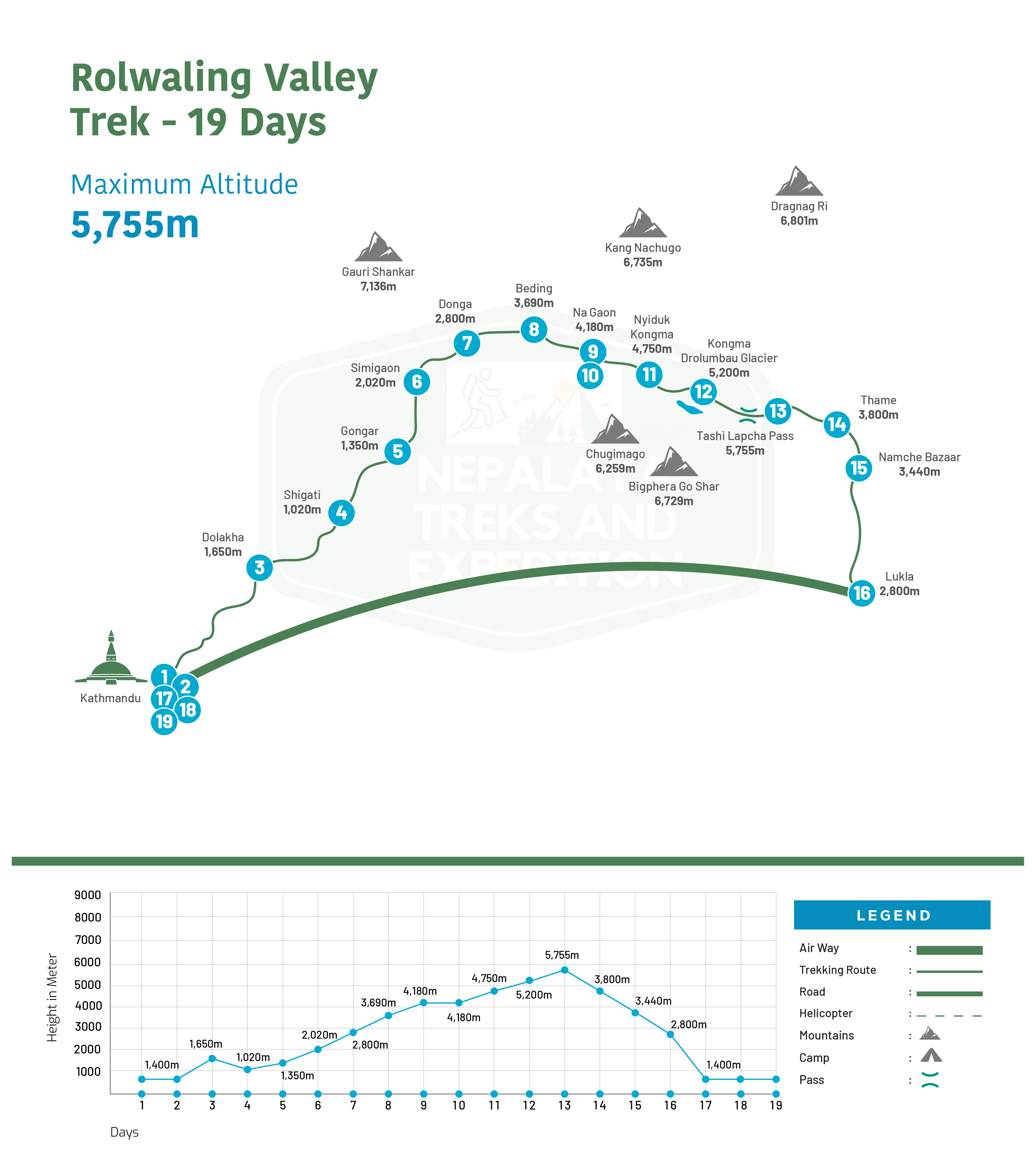
Route Map
Inclusion / Exclusion
Inclusion
- Airport pickup and drop-off in Kathmandu by private vehicle.
- Standard hotel accommodation in Kathmandu on Days 1, 2, 17, and 18.
- Teahouse or mountain lodge accommodation where available during the trekking sections, with designated camping arrangements in remote areas where teahouse accommodation is unavailable.
- Overnight camping or designated trekking accommodation around Drolumbau Glacier and the Tashi Lapcha Pass section, where teahouse facilities are unavailable.
- Breakfast, lunch, and dinner throughout the trekking duration.
- Transportation by bus from Kathmandu to Dolakha on Day 3.
- Transportation by ground from Dolakha to Shigati on Day 4.
- Flights from Lukla to Kathmandu on Day 17.
- A licensed and experienced trekking guide throughout the journey.
- Porter service for carrying the luggage of the trekkers.
- Required trekking permits and applicable entrance fees included in the trekking package.
- Basic first aid support during the trek.
- Government taxes and applicable service charges.
Exclusion
- International airfare to and from Nepal.
- Nepal entry visa fee.
- Travel insurance covering high-altitude trekking and emergency evacuation.
- Helicopter evacuation and medical expenses.
- Meals in Kathmandu, except those which are mentioned in trekking packages specifically.
- Gear and clothing used for trekking like trekking shoes, thermal clothes, gloves, trekking pants, jacket, and backpacks.
- Technical equipment necessary for the Tashi Lapcha Pass Trek if needed as per season and trails.
- Personal costs for Internet, laundry, charging facilities, phone calls, and showers.
- Medical expenses and other expenses related to medicine.
- Traveling and accommodation charges in case of any delay or problem.
- Tips for the guide, porters, driver, and other trekking staff.
- Other expenses apart from the above mentioned cost inclusions.
Check List
The 19-day Rolwaling Valley Trek via Tashi Lapcha Pass requires careful packing because the route passes through a wide range of environments, from the relatively mild conditions of Kathmandu and the lower valleys to the cold, remote, and high-altitude terrain around Na Gaon, Nyiduk Kongma, Drolumbau Glacier, and Tashi Lapcha Pass at 5,755 meters. Weather and trail conditions can change quickly at higher elevations, so you should carry layered clothing, reliable trekking equipment, and suitable protection against cold, wind, snow, and rain.
General
- Four-season or all-season sleeping bag suitable for high-altitude trekking
- Warm down or synthetic insulated jacket
- Duffle bag for trekking equipment
- Windproof and waterproof outer shell jacket
- Daypack of around 25–35 liters
- Rain cover for your backpack
- Trekking poles
- Gaiters, particularly for snowy or muddy conditions
- Backpack or duffle bag liner to protect your belongings from moisture
Headwear & Accessories
- Warm woolen hat that covers your ears
- Sun hat or cap
- Neck gaiter or buff
- UV-protection sunglasses
- Headlamp with spare batteries
- Sunscreen with SPF 35–60
- Lip balm with SPF
- Lightweight face covering or buff for cold and windy conditions
Hands
- Lightweight trekking gloves
- Warm woolen or insulated gloves
- Waterproof gloves or over-mittens for snowy and wet conditions
- Glove liners, if preferred
Upper Body Clothing
- Moisture-wicking trekking T-shirts
- Long-sleeve trekking shirts
- Thermal base-layer tops
- Fleece or woolen jacket
- Warm insulated jacket
- Waterproof and windproof outer shell
- Additional warm mid-layer for high-altitude sections
- Sports bra for women trekkers
Lower Body Clothing
- Thermal leggings or base-layer pants
- Trekking pants
- Waterproof and windproof trekking pants
- Fleece or insulated pants for high elevations
- Lightweight casual pants for evenings in Kathmandu and lower settlements
- Comfortable underwear
- Moisture-wicking base layers
Footwear
- Sturdy waterproof trekking boots with good ankle support
- Warm trekking socks
- 4–5 pairs of trekking socks
- Sock liners, if preferred
- Camp sandals or comfortable camp shoes
- Lightweight sneakers for Kathmandu, if desired
- Gaiters for snow, mud, and wet trail conditions
- Microspikes or suitable traction equipment if recommended according to seasonal conditions
- Crampons or other technical equipment only if required by current Tashi Lapcha Pass conditions and arranged with the trekking team
First Aid & Medication
- Personal prescription medicines
- Basic first-aid kit
- Adhesive bandages
- Blister treatment kit
- Pain relievers such as paracetamol or ibuprofen
- Any altitude-related medication prescribed or recommended by your doctor
- Antiseptic or antibacterial cream
- Anti-itch or insect-bite cream
- Oral rehydration salts
- Water purification tablets or drops
- Personal medication and medical supplies sufficient for the entire trek
Toiletries & Personal Hygiene
- Toothbrush and toothpaste
- Biodegradable soap and shampoo
- Hand sanitizer
- Wet tissues
- Toilet paper
- Quick-drying towel
- Nail clipper
- Moisturizer and lip balm
- Personal hygiene products
- Small plastic or waterproof bags for wet or dirty clothes
- Small waste bags for carrying personal rubbish
Important Documents
- Original passport
- Nepal visa or visa information, if required
- Passport-size photographs
- Travel insurance documents covering high-altitude trekking
- Emergency contact information
- Copies of important travel documents
- Flight tickets and travel itinerary in printed and electronic formats
- Copies of any required trekking permits or related documents, if provided to you
Electronics
- Mobile phone
- Power bank
- Charging cables
- Universal travel adapter
- Camera and memory cards
- Spare camera batteries
- Headlamp and spare batteries
- Smartwatch or GPS device, if desired
- Portable charging equipment suitable for remote trekking conditions
Optional Items
- Hydration bottle or water bladder
- Portable water filter or purifier
- Energy bars, nuts, dried fruits, or other lightweight snacks
- Notebook and pen
- Book or playing cards
- Earphones or headphones
- Binoculars
- Small thermos or insulated water bottle
- Small repair kit
- Lightweight dry bags for organizing clothing and electronics
Trip FAQs
-
1. Is the Rolwaling Tashi Lapcha Pass Trek Suitable for Beginners?
No. The Rolwaling Tashi Lapcha Pass Trek is a strenuous and challenging high-altitude trek recommended for physically fit trekkers with previous experience in demanding mountain environments. It includes long treks, ascent and descent, tough terrains, glaciers and crossing of Tashi Lapcha Pass, which is at an altitude of 5,755 m. -
2. How do I prepare for the Rolwaling Tashi Lapcha Pass Trek?
You need to prepare for the trek several weeks or months prior to your trek by undertaking regular hiking, walking, running, cycling, climbing staircases and performing other cardiovascular exercises. The strengthening of leg muscles and building up of stamina is essential for this trek. You should get accustomed to trekking poles and also carrying a day pack while trekking on long hike days. -
3. How long does the Rolwaling Tashi Lapcha Pass Trek last?
The itinerary spans a period of 19 days. This includes the days spent on arrival and sightseeing in Kathmandu, travel to Dolakha and Shigati, trekking in Rolwaling valley, crossing of Tashi Lapcha Pass, trekking further to Thame and Namche Bazaar and Lukla and flying back to Kathmandu. -
4. What is the highest point of the trek?
The highest point of the itinerary is Tashi Lapcha Pass at around 5,755 meters above sea level. The pass is crossed after trekking through the high-altitude glacier terrain around Drolumbau Glacier. -
5. How difficult is the Rolwaling Tashi Lapcha Pass Trek?
The trek is difficult because of its remote high-altitude terrain, long trekking days, steep ascents and descents, and glacial sections. Crossing Tashi Lapcha Pass is the most difficult part of the trek. -
6. Which are the difficult stretches of this trek?
Some of the difficult stretches of this trek include the stretches starting from Na Gaon all the way to Nyiduk Kongma, the Drolumbau Glacier, and finally Tashi Lapcha Pass. High altitude, cold weather, rocky terrain, snow, and ice can make these sections particularly challenging. -
7. Is there a need for technical mountaineering for this trek?
The itinerary does not describe the trek as a technical mountaineering expedition. However, seasonal conditions around Tashi Lapcha Pass may require traction equipment or other technical gear, depending on snow, ice, and trail conditions. -
8. What can I expect to see during this trek?
You can expect to see remote mountain villages, forests, rivers, alpine landscapes, glaciers, rocky valleys, snow-covered peaks, and Sherpa settlements. This trek passes through the beautiful scenery of both the Rolwaling and Khumbu regions. -
9. What kind of accommodation is available during the trek?
Accommodation on this itinerary ranges from hotels in Kathmandu to teahouses, mountain lodges, and designated camping arrangements along the trekking route. In the higher sections near Drolumbau Glacier and Tashi Lapcha Pass, overnight stays are arranged through camping or other designated trekking arrangements because teahouse facilities are unavailable. -
10. What kind of food do we have on this trek?
Food provisions will be organized from the mountain accommodation and settlements available on the route. However, as you venture further into the more isolated Rolwaling Valley, the variety of food options becomes quite limited. -
11. Are there drinking water options on this trek?
Water may be available from settlements, teahouses, and mountain sources along the route. Carry reusable water bottles and purify water from local sources using suitable purification tablets, drops, or a water filter. -
12. Is altitude sickness a danger for this trek?
Yes, altitude-related illness is a significant concern because the trek reaches 5,755 meters and includes several days at high elevation. The route contains an acclimatization day at Na Gaon at about 4,180 meters, followed by climbing to higher altitude parts. -
13. What are the signs of altitude sickness?
Common warning signs can include headache, dizziness, nausea, vomiting, unusual fatigue, loss of appetite, and shortness of breath. If you experience any of these signs at altitude, you should notify your guide immediately. -
14. How can I prevent altitude sickness?
You should ascend slowly and steadily, hydrate well, eat balanced meals, rest enough and follow your guide’s advice in acclimatization. -
15. What essential equipment do I need?
You should pack warm layered clothes, waterproof and windproof gear, strong trekking boots, gloves, a hat, sunglasses, a suitable sleeping bag for cold weather, head lamp, trekking poles, your personal medication, water bottles, and all other essential trekking gear. -
16. Is there any special equipment needed to climb the Tashi Lapcha Pass?
Additional equipment may be required for the Tashi Lapcha Pass depending on the season, snow and ice conditions, and trail conditions. Snow, ice, and steep terrain may require traction equipment such as microspikes or crampons, along with other technical equipment where necessary. The trekking team will tell you what to bring depending on current conditions. -
17. Is it possible to rent trekking equipment in Kathmandu?
Yes. It is possible to either rent or buy the equipment in Kathmandu prior to the trek. You should always inspect the size, condition, and fitness of the equipment you are going to rent. -
18. Will I have a guide and porters?
Yes. A trekking team will accompany you and assist with logistics, navigation, pacing, and carrying the designated trekking equipment. The guide will help maintain an appropriate pace and monitor the group for signs of altitude-related problems. -
19. Why do you need a guide for the Tashi Lapcha Pass Trek?
It will be helpful to have a guide for this trek since it involves remote locations with high-altitude glaciers. -
20. Can I do a private Rolwaling Tashi Lapcha Pass Trek?
Certainly. The Rolwaling Tashi Lapcha Pass Trek could be arranged as a private tour for any travelers like an individual, couple, family, friends, and also for private groups. A private tour allows you to enjoy more flexibility in respect of your travel timing and walking pace. -
21. Can I choose my desired departure dates?
Certainly, you may depart on a private basis according to your desired travel dates, taking into account accommodation, transportation, weather, trails, and other operational factors. -
22. Which season is best for Rolwaling Tashi Lapcha Pass Trek?
Spring and autumn are generally considered the most favorable seasons for high-altitude trekking in Nepal. However, the weather and trail conditions around Tashi Lapcha Pass change very rapidly, and the possibility of passing through the pass depends upon snow, ice, weather, and trail conditions. -
23. Does weather influence the crossing of Tashi Lapcha Pass?
Yes. The weather and condition of the trail can affect crossing in a major way. Snow, winds, bad visibility, and slippery conditions may make it very difficult or impossible to cross the pass. -
24. Can I cross Tashi Lapcha Pass year-round?
Not necessarily. The possibility of crossing depends on weather, trail conditions, snow, ice, and the current condition of the pass. Your trekking team will evaluate the situation and make their decision.Transportation and Flights -
25. How do I reach the Rolwaling Valley?
The itinerary begins with road travel from Kathmandu toward Dolakha and then continues toward Shigati before the trekking section begins. From Shigati, the journey continues on foot through the Rolwaling Valley. -
26. Could the Lukla flight be delayed?
Yes. Flights between Lukla and Kathmandu can be delayed or disrupted by poor visibility, strong winds, rain, or other unfavorable weather conditions. Therefore, it is advisable to keep some flexibility in your travel schedule. -
27. What permits are required for the Rolwaling Tashi Lapcha Pass Trek?
The exact permit requirements depend on the route and applicable regulations, so your trekking company should confirm the permits required for your departure. You should talk to your trekking company about the required permit for this trek. -
28. Do we need travel insurance for this trek?
Travel insurance is highly advised for this trek, which involves traveling at an altitude of 5,755 metres through remote mountain areas.
All Inclusive Cost
USD 2250
Per Person
BOOK NOW QUICK ENQUIRY- Best Price Guarantee
- Hassle-Free Booking
- Team of highly experienced Experts
You may also like !!
Our Best Selling Packages You May Like.