Manaslu Base Camp Trek
Overview
The Manaslu Base Camp Trek is an adventurous journey of 15 days to the Manaslu region. Your journey begins with a scenic drive from Kathmandu to Machha Khola, after which the trail follows the Budhi Gandaki Valley. During the trek, you pass through forests, villages, waterfalls, suspension bridges, and diverse mountain terrain. As you gain altitude, the landscape gradually changes into alpine terrain.
This trek also passes through important settlements, including Jagat, Deng, Namrung, Shyala, Samagaun, Samdo, and Dharamsala. You also have an acclimatization day in Samagaun, with an optional hike to Manaslu Base Camp or Birendra Lake before continuing the trek. A major highlight of this journey is the challenging crossing of Larkya La Pass (5,106m), followed by a descent through green valleys towards Bhimthang, Tilije, and Dharapani. This trip ends with a transfer to Besisahar, and from there back to Kathmandu.
This trek also passes through important settlements, including Jagat, Deng, Namrung, Shyala, Samagaun, Samdo, and Dharamsala. You also have an acclimatization day in Samagaun, with an optional hike to Manaslu Base Camp or Birendra Lake before continuing the trek. A major highlight of this journey is the challenging crossing of Larkya La Pass (5,106m), followed by a descent through green valleys towards Bhimthang, Tilije, and Dharapani. This trip ends with a transfer to Besisahar, and from there back to Kathmandu.
Extra Highlights of the Manaslu Base Camp Trek
The Manaslu Base Camp Trek allows you to explore Himalayan wilderness, traditional villages, Tibetan-influenced Buddhist culture, diverse landscapes, and the challenging Larkya La Pass. This trek follows the Budhi Gandaki Valley from Machha Khola towards high-altitude villages such as Samagaun, Samdo, and Dharamsala and includes an acclimatization hike to Manaslu Base Camp or Birendra Lake.Some of the major attractions on the trek include the following:
- Experience the remote and rich cultural villages of the Manaslu region.
- Experience the breathtaking view of Mount Manaslu and the Himalayan Mountains.
- Trek through the Budhi Gandaki Valley, passing rivers, forests, and rugged mountain terrain.
- Explore the influence of Tibetan culture on the upper Manaslu region.
- See Pungyen Monastery while trekking to Samagaun.
- Spend an acclimatization day in Samagaun with an optional hike to Manaslu Base Camp or Birendra Lake.
- Experience a hike to Manaslu Base Camp up to an elevation of 4,800 meters.
- Visit Birendra Lake along with its stunning surroundings of glaciers and mountains.
- Navigate through the challenging Larkya La Pass at an altitude of 5,106 meters above sea level.
- Witness the change in the landscape from lush forests to valley streams and then to the alpine meadows and mountains.
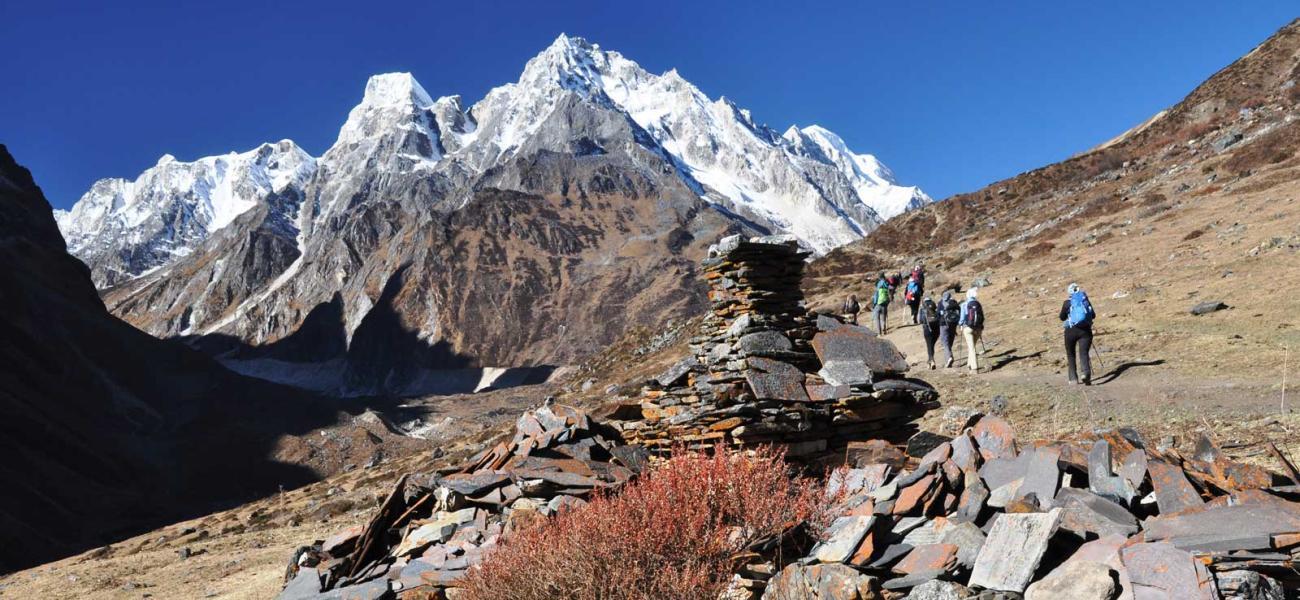
- Experience Buddhist prayer flags, chortens, mani walls, and monasteries along the way.
- Witness farming, livestock herding, and the lifestyle of mountain villages.
- Pass through pine, rhododendron, and other Himalayan vegetation before descending from the high mountains through Bhimthang and Tilije towards Dharapani.
- Combine cultural experiences, wilderness, mountain scenery, and high-altitude adventure on one trekking route.
Best Time for the Manaslu Base Camp Trek
Spring and autumn are regarded as the best seasons for the Manaslu Base Camp Trek because the former provides ideal trekking weather with moderate temperatures, while the latter offers clear views of the Himalayas and good trekking temperatures. Winter results in colder weather with snowfall in the higher reaches, and monsoon brings rain, muddy tracks, and even landslides, especially in the lower reaches of the trail.
1. Spring (March-May)
Spring is among the most ideal seasons for the Manaslu Base Camp Trek. There is an improvement in the temperature, the skies are generally clear, and the lower portions of the trail turn green. Rhododendrons and other flowers start blooming, making the forests more colorful. The higher areas around Samdo, Dharamsala, and Larkya La remain cold, but spring generally offers favorable trekking conditions.
2. Fall (September-November)
Autumn is also a wonderful season for the Manaslu Base Camp Trek. The weather is quite stable following the monsoon, and there are good views of Manaslu and other Himalayas from the clear sky. Temperature at lower and middle altitudes in October and November makes these two months the most preferred ones.
3. Winter (December-February)
Winter is characterized by cold temperatures and snowfall in the higher reaches of the Manaslu Base Camp Trek. Temperatures drop significantly around Samdo, Dharamsala, and Larkya La. Heavy winter snowfall can affect trail conditions and make crossing high mountain passes more challenging. So the trekkers must have winter trekking gear.
4. Monsoon (June-August)
Monsoon comes with rainy weather, cloudy skies, muddy trails, and chances of landslide especially in the lower portions of the trail. Traveling by road from Kathmandu via Machha Khola, Besisahar, and back to Kathmandu will be affected by the poor road conditions in the monsoon. However, the higher reaches of the Manaslu region generally receive less rainfall and remain relatively drier during the monsoon.
Accommodation and Meals during the Manaslu Base Camp Trek
Accommodation during the Manaslu Base Camp Trek is primarily provided by local teahouses and lodges along the route. Rooms are generally basic and commonly arranged on a twin-sharing basis. Facilities become simpler as you move towards the higher settlements of Samdo and Dharamsala. In Kathmandu, accommodation is provided at a comfortable tourist-standard hotel.
- Food is available at teahouses along the trail, and this includes:
- Breakfast: Eggs, bread, pancakes, Tibetan bread, tea, and coffee.
- Dinner and lunch: Dal bhat, noodles, rice, pasta, soup, vegetables, potatoes, and other basic meals.
- Trekkers should carry a reusable water bottle and use purification tablets, a water filter, or another suitable purification method.
- Food is generally available at teahouses along the trekking route, although choices become more limited at higher elevations.
- Food options in Samdo and Dharamsala are generally more limited because transporting supplies to these remote settlements is challenging.
Manaslu Base Camp Trek: What Makes It Popular?
Manaslu Base Camp Trek is a trek in which people can experience the remote mountain scenery, Himalayan villages, Tibetan-influenced Buddhist culture, and the challenges of high-altitude trekking. The Manaslu Base Camp Trek follows the Budhi Gandaki Valley through increasingly challenging terrain to Samagaun, where you spend an acclimatization day with an optional hike to Manaslu Base Camp or Birendra Lake.Itinerary highlights include:
- Drive to Machha Khola from Kathmandu through rural hills and mountains.
- Head for the higher parts of Manaslu via the valley of Budhi Gandaki.
- Experience Tibetan influence in the local culture, architecture, and religious traditions.
- Explore the Pungyen Monastery near Samagaun.
- Spend one day acclimating in Samagaun.
- Hike to Manaslu Base Camp or Birendra Lake.
- Trek towards the high-altitude villages of Samdo and Dharamsala.
- Viewing magnificent scenery of Manaslu and the surrounding Himalayas.
- Crossing Larkya La Pass at 5,106 meters.
- Experience the change of landscapes from forest and river valleys to Alpine and high-altitude deserts.
- Experience traditional agriculture and mountain villages.
- Walk down to Bhimthang and Tilije towards Dharapani.
- End the trek with drives to Besisahar and Kathmandu.
Culture Experience on the Manaslu Base Camp Trek
The Manaslu Base Camp Trek allows you to learn about the cultures and ways of life of the people living around the Budhi Gandaki Valley and upper regions of Manaslu. As you advance towards Namrung, Shyala, Samagaun, and Samdo, Tibetan cultural influences become increasingly evident in the traditional stone houses, Buddhist monasteries, prayer flags, chortens, and mani walls.Some of the cultural interactions that are possible during this Manaslu trekking experience are:
- View traditional stone and wooden structures of Himalayan villages.
- Visit Pungyen Monastery near Samagaun village.
- View yaks and other livestock grazing on the mountains.
- Learn about the lifestyles of people in Samagaun and Samdo.
- Learn about traditional agriculture and livestock rearing practices of the mountain villages.
- Learn how culture changes according to the rise in elevation of the trail through hills to the Himalayas.
Altitude and Acclimatization for the Manaslu Base Camp Trek
Altitude is an important factor during the Manaslu Base Camp Trek, as the trail gradually ascends from Machha Khola at 870 meters to Larkya La Pass at 5,106 meters. The acclimatization day in Samagaun helps your body adjust to the increasing altitude before continuing towards Samdo, Dharamsala, and Larkya La Pass.
- The trek begins in Machha Khola, which lies at approximately 870 meters.
- The highest elevation that one will encounter during the trekking is Larkya La Pass, which rises to 5,106meters.
- The path crosses Jagat, Deng, Namrung, Shyala, Samagaun, Samdo, and Dharamsala.
- There is an acclimatization day, which will take place at Samagaun before ascending to higher points.
- One can spend the acclimatization day on a hike to Birendra Lake or Manaslu Base Camp.
- Maintain a steady pace while trekking, especially above 3,000 meters.
- Drinking enough water along the way will help.
- Having a balanced diet will provide you with enough energy.
- Symptoms of altitude sickness include headache, dizziness, nausea, fatigue, and difficulty sleeping.
- If one feels any symptoms of altitude sickness, one should inform their guide.
Difficulty Level of the Manaslu Base Camp Trek
The Manaslu Base Camp Trek is a moderate-to-strenuous trek due to its remote setting, long trekking days, varied terrain, increasing altitude, and challenging Larkya La Pass crossing. Trekking days vary from 3 to 10 hours on average; the longest and most difficult day in the trek is the trek from Dharamsala to Bhimthang over Larkya La.
- The trek entails numerous uphill and downhill climbs, rocky terrain, stone paths, forests, river valleys, and high altitude.
- Trekking days generally involve 3 to 10 hours of walking.
- High-altitude settlements such as Samagaun, Samdo, and Dharamsala may be tiring because of the increasing altitude.
- The highest point of the trek is Larkya La Pass, which stands at 5,106 meters.
- Acclimatization day in Samagaun helps your body adjust to the increasing altitude.
- Good cardiovascular fitness and some previous trekking experience are beneficial.
- Previous high-altitude trekking experience is not essential for well-prepared trekkers, although it can be beneficial.
- Going at an even pace conserves your energy during the trek.
- Proper hydration, nutrition, rest, and proper trekking gear are important.
- Trekking poles may help when trekking uphill, downhill, and on rocky and steep paths.
Permits Required for the Manaslu Base Camp Trek
Manaslu Base Camp Trek passes through restricted and conservation areas, so trekkers must obtain the appropriate permits before and during the trek. These permit requirements are broadly similar for the Manaslu Circuit Trek, since both routes cross the same restricted zone. The main permits required for this trek include the Manaslu Restricted Area Permit (RAP), Manaslu Conservation Area Permit (MCAP), and Annapurna Conservation Area Permit (ACAP) for the section through the Annapurna Conservation Area.
- Manaslu Restricted Area Permit (RAP): This permit is required for trekking through the restricted areas of the Manaslu region. The permit must be obtained through an authorized trekking agency such as Nepalaya Treks, and the costs vary depending on the season and number of days in the restricted zone.
- Manaslu Conservation Area Permit (MCAP): This permit is required for trekking through the Manaslu Conservation Area. It helps to conserve the area and manage its resources.
- Annapurna Conservation Area Permit (ACAP): After crossing Larkya La and descending towards Dharapani, the route enters the Annapurna Conservation Area. This means one needs an Annapurna Conservation Area Permit for the particular zone of the trekking trail.
- Trekkers' Information Management System (TIMS): This card helps maintain trekking records and supports safety and emergency management. For organized treks, the trekking agency generally handles the necessary permits and documentation.
Insurance for the Manaslu Base Camp Trek
Comprehensive travel insurance is strongly recommended for the Manaslu Base Camp Trek because the route reaches 5,106 meters at Larkya La Pass and passes through remote mountain areas where access to medical facilities can be limited.
- Ensure that your insurance covers high-altitude trekking.
- Ensure that your insurance covers high-altitude trekking at elevations of up to 5,106 meters.
- Find out if emergency helicopter evacuation and the costs of such evacuation are covered.
- Check whether your policy covers trekking-related injuries and emergency medical services.
- If need be, review your coverage on trip cancellations and interruptions.
- Carry your insurance papers during the trek.
- Give a copy of your insurance information to your trekking company.
- Do not assume that standard travel insurance automatically covers high-altitude trekking.
- Consider the height restrictions, evacuation scenarios, exclusions, trekking insurance cover, and claim process before embarking on the trekking trip.
Why Choose This Itinerary?
The Manaslu Base Camp Trek itinerary is designed for adventurous travelers seeking to explore the remote Manaslu region through a high-altitude trekking route.
- Discover the remotest Manaslu region between Machha Khola and Dharapani.
- Visit traditional villages of Jagat, Deng, Namrung, Shyala, Samagaun, and Samdo.
- Visit Pungyen Monastery on the way to Samagaun.
- Spend an acclimatization day in Samagaun; either walk to Birendra Lake or to the Manaslu Base Camp.
- Enjoy the view of Mount Manaslu and other Himalayan mountains.
- Enjoy the change of landscape from forest and river valley to alpine and high altitude zone.
- Go through pine, rhododendron, and other Himalayan forests.
- Meet local people working on their farms and pastures.
- Witness the change in landscape from barren high-altitude zone to green valleys after passing through Larkya La.
- End the trekking part of the journey at Dharapani and then go towards Besisahar and Kathmandu.
Safety on the Manaslu Base Camp Trek
Safety is essential on the Manaslu Base Camp Trek because the route passes through remote mountain terrain and crosses Larkya La Pass at 5,106 meters.
- Follow the acclimatization plan and do not ascend too fast.
- Keep a moderate speed and do not get too tired when moving at altitude.
- Tell your guide if you feel a headache, nausea, dizziness, abnormal fatigue, difficulty breathing, or sleep disorders.
- Be prepared for rapidly changing weather and trail conditions, especially when climbing at altitude.
- Carry sufficient quantities of water and a means of purifying it.
- Bring sufficient clothes that will be warm, windproof, and waterproof.
- Stay together with your group and tell your guide before moving off the trail.
- Follow road safety precautions during transportation between Kathmandu, Machha Khola, Dharapani, and Besisahar.
- Follow all the rules of permit and trekking.
- Have all the insurance documents with you throughout the whole trek.
- Your insurance must cover you well enough for the trek and emergency evacuation.
Responsible Tourism
Responsible tourism is crucial for the Manaslu Base Camp Trek due to the fact that this path includes various conservation zones, villages, monasteries, and environments of the mountains that need to be protected. Responsible tourism is essential as it preserves the natural environment and helps the local communities.
- Do not litter and dispose of your trash properly.
- Walk only along the designated trekking route.
- Pay due respect to local culture and places of worship.
- Obtain permission before photographing the local people, their traditions, and other culturally important acts.
- Respect the guides, porters, teahouse owners, and other locals.
- Do not waste water in remote mountain communities.
- Do not damage plants, disturb wildlife, or damage monasteries, chortens, stones, or other natural and cultural heritage.
- Take away non-biodegradable trash whenever possible.
Group Size
The Manaslu Base Camp Trek can be arranged for couples, families, friends, colleagues, and private groups. A guide and porter from Nepalaya Treks can assist with navigation, logistics, acclimatization, and baggage handling throughout the trek.
- The guide will conduct the trek and offer help in navigating and acclimatizing.
- The porters will carry heavy bags, and trekkers will carry light daybags themselves.
- Small groups will walk at a convenient pace according to the fitness of their members.
- The private group can have greater convenience regarding the pace and arrangement per day.
- Private groups can organize their departure.
- Group size can also be arranged as per the travelers' needs.
Private Departure Options: Tourist Bus, Private Vehicle, or Flight
Private departures are available for travelers who want to trek with family members, friends, partners, or a private group. Private departures offer greater flexibility in choosing departure dates, trekking pace, transportation, and accommodation where possible.
- Choose a personal departure date that suits you.
- Select tourist bus or private transportation where available and appropriate for the route.
- Adjust the walking pace according to the fitness level of the group.
- Trek exclusively with your family, friends, partner, or private group.
- Arrange transportation and accommodation according to group requirements where possible.
- Private departures are suitable for travelers seeking a more flexible trekking experience.
Equipment Rental Information
Travelers who do not own all the necessary trekking equipment can rent many basic items in Kathmandu before beginning the Manaslu Base Camp Trek. Renting can be particularly useful for equipment required mainly for the colder and higher sections around Samdo, Dharamsala, and Larkya La.
- Jackets, trekking poles, duffle bags, sleeping bags, and other trekking equipment can be rented in Kathmandu.
- Renting equipment can reduce the cost of purchasing gear used only occasionally.
- A proper sleeping bag and enough warm clothing are essential for higher regions.
- Trekking poles provide additional support on steep ascents, descents, and rocky sections.
- Wear warm clothes as you get close to Samdo, Dharamsala, and Larkya La.
- Consult trekking experts in case you have doubts regarding the gear needed.
- Inspection of the rented gear should be done before departing from Kathmandu.
Trip Highlights
- Make a descent into Bhimthang and Tilije, where the landscapes get greener and warmer as you go down.
- Enjoy panoramic Himalayan views from Dharamsala and Larkya La.
- Observe the changing landscapes, from green valleys and forests to dry alpine terrain and snow-covered mountains.
- Cross Larkya La Pass at an elevation of 5,106 meters, the highest point and one of the most challenging sections of the trek.
- Hike to Manaslu Base Camp, located at an elevation of approximately 4,800 meters, as part of the acclimatization day.
- Have an acclimatization day in Samagaun with the option of trekking to Manaslu Base Camp or Birendra Lake.
- Enjoy excellent views of Mount Manaslu and other Himalayan peaks as you enter the high valleys.
- Visit Pungyen Monastery while trekking from Shyala to Samagaun.
- See Tibetan influence in architecture and culture in the upper Manaslu settlements.
- Visit traditional mountain villages such as Jagat, Deng, Namrung, Shyala, Samagaun, Samdo, and Bhimthang.
- Walk along the Budhi Gandaki River through deep valleys, dense forests, rocks, waterfalls, and suspended bridges.
- Trek through the remote Manaslu region, one of Nepal’s most culturally rich and scenically diverse trekking areas.
Itinerary
Day 1: Arrival in Kathmandu
Upon your arrival at Tribhuvan International Airport in Kathmandu, a representative from our team will receive you and will take you to your hotel. After checking into your hotel, you can rest and recover from the journey. Depending on your arrival time, you can explore the surrounding area, visit nearby attractions, or rest at the hotel. You will also meet your trekking guide, who will brief you about the trekking route, trail conditions, permits, and safety precautions. In addition, you can check your trekking gear to ensure you are fully prepared for the trek. After completing the preparations, you will spend the night at the hotel.
- Travel Distance: Approx. 5–10 km (airport to hotel)
- Travel Hours: Approx. 30–60 minutes
- Accommodation: Hotel in Kathmandu
- Meals Included: Breakfast
Day 2: Drive from Kathmandu to Machha Khola (870 m) : 7–8 hours
Day 3: Trek from Machha Khola to Jagat (1,340 m): 5–6 hours
Day 4: Trek from Jagat to Deng (1,860 m): 6–7 hours
Day 5: Trek from Deng to Namrung (2,630 m): 6–7 hours
Day 6: Trek from Namrung to Shyala (3,500 m): 5–6 hours
Day 7: Trek from Shyala to Samagaun via Pungyen Monastery (3,530 m): 4–5 hours
Day 8: Acclimatization Day in Samagaun with Hike to Manaslu Base Camp (4,800 m) or Birendra Lake: 6–7 hours
Day 9: Trek from Samagaun to Samdo (3,875 m): 3–4 hours
Day 10: Trek from Samdo to Dharamsala / Larkya Phedi (4,450 m): 4–5 hours
Day 11: Trek from Dharamsala to Bhimthang via Larkya La Pass (5,106 m) (Bhimthang: 3,590 m): 8–10 hours
Day 12: Trek from Bhimthang to Tilije (2,300 m): 5–6 hours
Day 13: Trek to Dharapani and Drive to Besisahar: 6–8 hours total
Day 14: Drive from Besisahar to Kathmandu: 6–7 hours
Day 15: Final Departure
Route Map
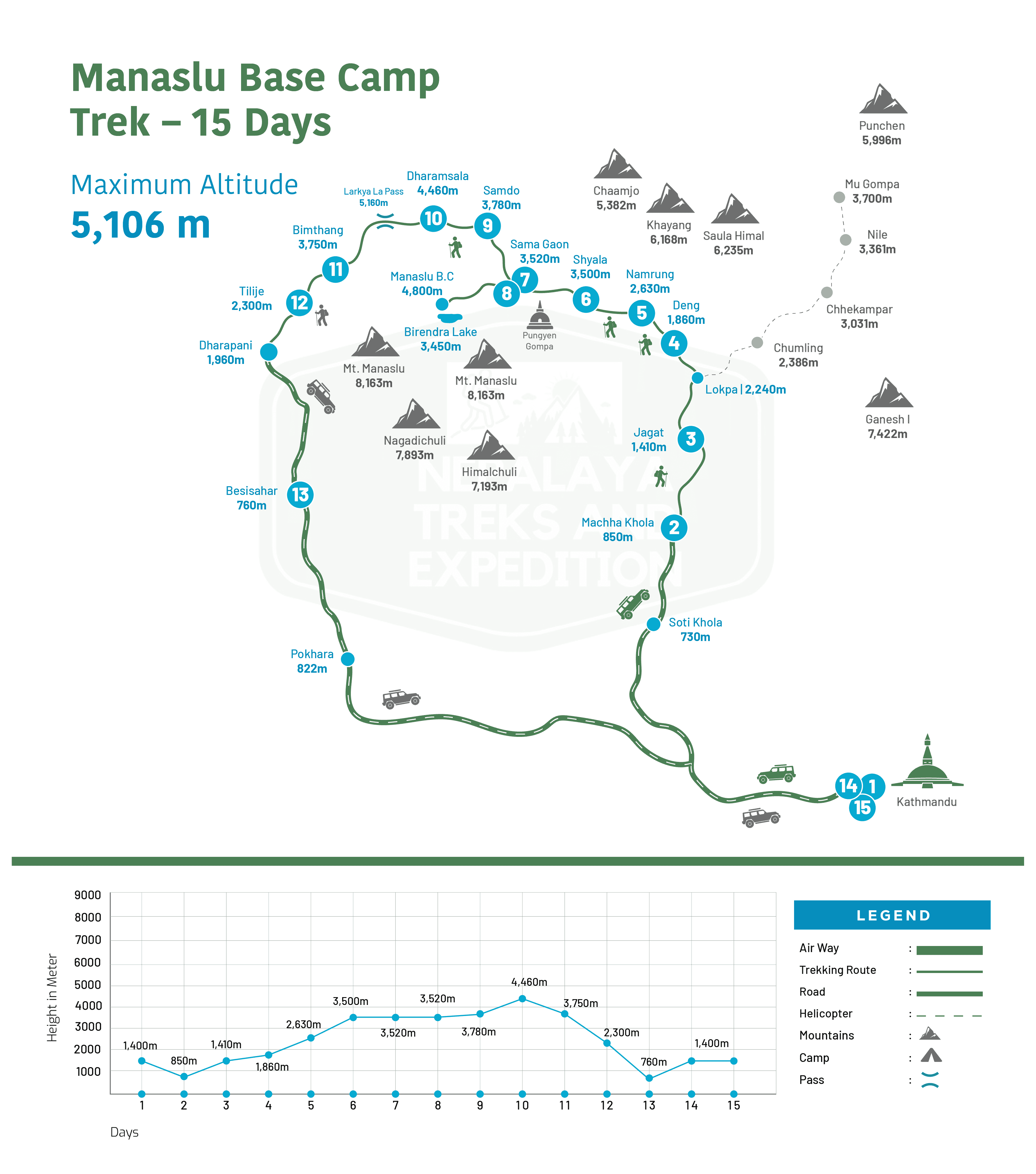
Inclusion / Exclusion
Inclusion
- Airport arrival and departure transfers in Kathmandu.
- Accommodation in Kathmandu before and after the trek.
- Accommodation at Teahouses while trekking.
- Breakfast, Lunch, and dinner while trekking.
- Experienced English-speaking trekking guide.
- Porter service.
- Manaslu Restricted Area Permit (RAP).
- Manaslu Conservation Area Permit (MCAP).
- Annapurna Conservation Area Permit (ACAP).
- TIMS or applicable trekking registration fees.
- Transportation from Kathmandu to Machha Khola.
- Transportation from Dharapani to Besisahar.
- Transportation from Besisahar to Kathmandu.
- Government and local taxes.
- Trekking agency service charges.
Exclusion
- International airfare to and from Nepal.
- Nepal entry visa fee.
- Travel and trekking insurance.
- Personal trekking equipment and clothing.
- Costs for renting equipment.
- Costs incurred by the individual in things such as laundry, phone and Internet connection charges.
- Snacks and personal beverages.
- Bottled and purified water.
- Charges for hot showers and electricity throughout the trip.
- Alcoholic beverages.
- Tips to the guides, porters and drivers.
- Helicopter evacuation in case of an emergency and related costs.
- Additional cost of accommodation, food or transport in case of any delay or bad weather or illness, etc.
- Any expenses not specifically mentioned under the cost inclusion section.
Check List
The Manaslu Base Camp Trek passes through varied climatic zones, from warm lower valleys to cold, high-altitude areas like Samdo, Dharamsala, and Larkya La. Packing in layers is essential, with lightweight clothing for the lower trail and warm, insulated gear for the higher sections. Here's a checklist to help you prepare.
General
- Sleeping bag and down jacket
- Duffle bag
- Lightweight windproof and waterproof jacket
- Comfortable daypack for daily essentials
Head, Ears, and Eyewear
- Warm hat covering the ears
- Sunglasses with UV protection
- Neck warmer or buff
- Sunscreen with SPF 35–60
- Headlamp with extra batteries
Hands
- Lightweight trekking gloves
- Warm shell gloves with inner liners
Upper Body
- Long-sleeve T-shirts
- Thermal tops
- Fleece or wool jacket
- Sports bras for women
- Windproof and waterproof shell jacket
Lower Body
- Thermal trousers
- Waterproof and windproof trousers
- Warm trekking trousers
- Comfortable trekking pants
- Extra casual or sports pants
Footwear
- Good-quality waterproof trekking boots
- Comfortable sandals
- 4–5 pairs of warm woolen socks
- Sock liners
- Light shoes or sneakers
First Aid and Medicines
- Adhesive bandages
- Blister treatment
- Personal pain-relief medicine
- Altitude sickness medicine
- Basic wound dressings and bandages
- Water purification tablets
- Personal prescription medicines, if required
Miscellaneous
- Original passport and passport-size photos
- Reusable water bottle and water filter or purification method
- Flight details and copies of important travel documents
- Personal bathroom kit, including toilet paper, hand wipes, towel, soap, and small plastic bags
Extra Useful Items
- Comfortable trekking poles
- Energy bars, dry fruits, or other lightweight snacks
- Power bank and charging accessories
- Camera with memory card, charger, and extra batteries
Trip FAQs
-
1. Is the Manaslu Base Camp Trek suitable for beginners?
Well-prepared beginners can undertake the Manaslu Base Camp Trek, although its long trekking days, high altitude, varied terrain, and Larkya La Pass crossing make it demanding. This trek involves long walking days, substantial altitude gains, varied mountain terrain, and a crossing of Larkya La Pass at 5,106 meters. Therefore, beginners should have adequate physical preparation before undertaking the trek. -
2. How do I prepare for the Manaslu Base Camp Trek?
In preparation for the Manaslu Base Camp Trek, you may engage in regular hiking, walking, stair climbing, running and cycling. Strength training of your legs to enable you to manage steep climbs and descents is also necessary. Practicing carrying a backpack and walking long distances regularly will help you get accustomed to the demands of the trek -
3. What is the highest point of Manaslu Base Camp trek?
The highest point of this trek is Larkya La Pass at 5,106 meters above sea level. It also entails the crossing of Dharamsala at approximately 4,450 meters and an optional hike to Manaslu Base Camp at about 4,800 meters. -
4. How Many Days Does the Manaslu Base Camp Trek Take?
This trek itinerary will take 15 days, including two days in Kathmandu, arrival, and departure day. This trek begins with a drive from Kathmandu to Machha Khola and through the Manaslu region to Larkya La Pass and then on to Dharapani and Besisahar. Trekkers with more time can also explore the Manaslu and Tsum Valley Trek, a longer itinerary that includes the Tsum Valley. -
5. How difficult is the Manaslu Base Camp Trek?
The Manaslu Base Camp Trek is considered moderate to strenuous in difficulty. It involves long hours of walking, steep ascents and descents, rocky and uneven trails, significant altitude gains, and challenging terrain. Therefore, you will need to be fit, well prepared, and adequately acclimatized as a trekker. With adequate preparation and fitness, the trek can be undertaken by both novice and experienced trekkers. -
6. Do I need any previous trekking experience?
Previous trekking experience is desirable but not necessary for prepared travelers. You must be physically fit to take long walks. And previous high-altitude trekking experience will be an additional advantage, especially near Dharamsala and Larkya La. -
7. What can I see along the trek?
Along the trek, you will enjoy the view of the Himalayas, traditional villages, Buddhist monasteries, forests, valleys, suspension bridges, alpine zones, and high altitudes. The main sights are Pungyen Monastery, Samagaun, Birendra Lake, Manaslu Base Camp, Samdo, Dharamsala, and Larkya La Pass. -
8. When is the best time for Manaslu Base Camp Trek?
Manaslu Base Camp Trek can be enjoyed during the spring (March to May) and autumn (September to November) seasons. These seasons generally offer stable weather, clear mountain views, and favorable trail conditions. Moreover, October and November are the months that attract the largest number of trekkers in the area. -
9. Can I do the trek in winter/monsoon?
The trek is possible during winter and monsoon, although snow, rain, muddy trails, landslides, and poor road conditions can make the journey more challenging. Winter can bring freezing temperatures and snow at higher elevations, while trekking in monsoon brings rain, muddy trails, landslides, and difficult road conditions, particularly in lower areas. -
10. What kind of accommodation is available?
You will stay in a tourist-standard hotel in Kathmandu and local teahouses or lodges during the trek. Rooms are generally basic and commonly arranged on a twin-sharing basis. Facilities become simpler in remote settlements such as Samdo and Dharamsala. -
11. What food is available during the trek?
Teahouses generally serve dal bhat, noodles, fried rice, pasta, soup, vegetables, potatoes, eggs, bread, pancakes, and Tibetan bread. Tea and coffee are also commonly available. Food choices become more limited at higher elevations. -
12. Can altitude sickness be a problem?
Yes. Altitude sickness can occur as you ascend to high elevations, particularly near Larkya La Pass at 5,106 meters. There is an acclimatization day at Samagaun before going up into the higher altitude areas. Gradual ascent, proper hydration, adequate rest, and a suitable trekking pace can help reduce the risk of altitude sickness. -
13. What are the symptoms of altitude sickness?
Some of the common symptoms include headaches, dizziness, nausea, vomiting, fatigue, loss of appetite, difficulty sleeping, and difficulty breathing. If you experience symptoms of altitude sickness or feel unwell, inform your guide immediately. -
14. What permits are needed for the Manaslu Base Camp Trek?
The usual permits required are the Manaslu Restricted Area Permit (RAP), Manaslu Conservation Area Permit (MCAP), and Annapurna Conservation Area Permit (ACAP). Applicable trekking registration requirements also need to be completed. -
15. Is technical equipment required?
No technical climbing equipment is normally required. However, you should carry warm clothes, thermal clothes, windproof and waterproof jackets, trekking shoes, sleeping bags, gloves, sunglasses, sunscreen, and trekking poles. -
16. Is trekking equipment available for rent in Kathmandu?
Many trekking items, including sleeping bags, down jackets, trekking poles, and duffle bags, can be rented in Kathmandu. Make sure that the equipment is fit and proper before commencing the trek.

All Inclusive Cost
BOOK NOW QUICK ENQUIRY- Best Price Guarantee
- Hassle-Free Booking
- Team of highly experienced Experts
You may also like !!
Our Best Selling Packages You May Like.