Everest Three Passes Trek
Overview
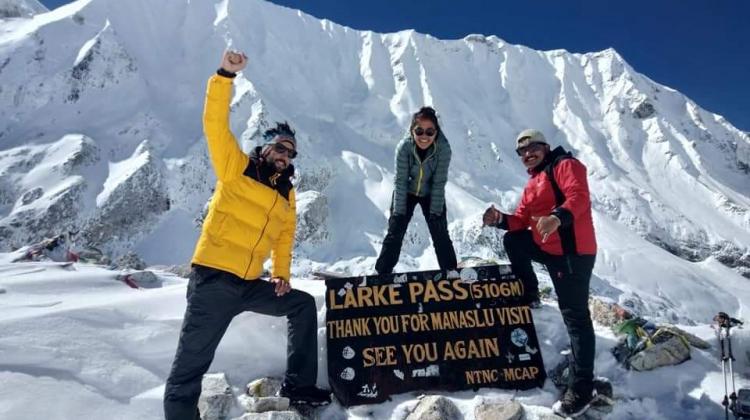
Enjoy a challenging and complete alternative to the classic Everest Base Camp Route with an unforgettable journey of the Everest Three Passes Trek from Nepalaya Treks. Lasting 17 days, this high-altitude circuit crosses three significant mountain passes and combines Everest Base Camp, Kala Patthar, the Gokyo Lakes, and remote Sherpa villages into an unforgettable Himalayan adventure. The three passes you cross are Kongma La (5,535m), Cho La (5,420m), and Renjo La (5,360m).
Throughout your journey, you have the opportunity to explore glacial valleys, cross suspension bridges, visit ancient monasteries, and enjoy spectacular views of Mount Everest, Lhotse, Makalu, Cho Oyu, Ama Dablam, and several other peaks. The well-planned itinerary also includes acclimatization days that help you adjust to the increasing altitude and trek more safely. All of this makes the Everest Three Passes Trek one of the most rewarding adventures in the Himalayas of Nepal.
Why Choose Everest Three Passes Trek?
Among others, some of the reasons why you would want to do this trek are:
- Well-planned itinerary with a gradual rise in altitude, making acclimatization and safe trekking easier.
- Complete circuit trek that avoids trekking the same path back and forth, thus experiencing different scenery at all times.
- Perfect balance between tough trekking at a high altitude and rest days.
- Explore both the famous trekking trails of Everest as well as the quieter, more tranquil valleys of Khumbu.
- Overnight stays in several Sherpa villages give you the opportunity to get a real cultural experience.
- Get a diverse experience trekking through forests, alpine areas, glacial moraines, mountain passes, river valleys, and high altitude lakes, all in one trek.
- Watch sunrises and sunsets over the Himalayan ranges from different viewing points.
- Best suited for trekkers who have completed the Everest Base Camp trek and are seeking something more.
- With the guidance of expert local guides, who are very well-versed with the mountains, weather, and the Sherpa culture.
- Tea houses on the trail to ensure you get the true Himalayan experience while trekking.
- Flexible itinerary, which can change according to the weather and mountain conditions at any point.
- An unforgettable sense of achievement after completing one of the world's most iconic and demanding trekking circuits.
What to Expect on the Everest Three Passes Trek
During the 17-day trek, you get to cross the three famous passes of Kongma La, Cho La, and Renjo La while visiting places like Everest Base Camp, Kala Patthar, Gokyo Lakes, and Gokyo Ri, among others.
While on this amazing expedition, one is sure to:
- Cross Kongma La (5,535m), Cho La (5,420m), and Renjo La (5,360m), the three legendary high passes in the Everest region.
- Find themselves adjacent to the world-famous Everest Base Camp (5,364m) beneath the towering Khumbu Icefall.
- Experience sunrise on the Himalayan range from the viewpoint of Kala Patthar (5,545m). The best place to see Mount Everest.
- Visit the summit of Gokyo Ri (5,357m) and experience an awesome sight of Everest, Lhotse, Makalu, Cho Oyu and many more.
- Experience the awesome blue-colored lakes of Gokyo and the giant Ngozumpa Glacier, the largest glacier in Nepal.
- Enjoy life in the traditional villages of the Sherpa along with their unique Buddhist culture.
- Stay in teahouses all through the trail.
- Experience an ever-changing environment from thick forests and flowing streams to glaciers and high valleys.
Additional Highlights of the Everest Three Passes Trek
Some of the amazing things that you will see during your trek include:
- Enjoy a thrilling mountain flying experience from Kathmandu to Lukla.
- Visit Everest Base Camp, Kala Patthar, Gokyo Lakes, and Gokyo Ri in a single adventure.
- Cross all three iconic high mountain passes of the Everest region.
- Trek through the UNESCO-listed Sagarmatha National Park.
- Visit Tengboche Monastery, which is the largest and most important monastery in the Khumbu.
- Explore the old Sherpa villages such as Namche Bazaar, Pangboche, Dingboche, Gokyo, Lungden, and Thame.
- Hike on the old trading routes which were followed by the Tibetan traders in the Himalayas.
- Explore the trekking routes which are less frequented than the well-known Everest Base Camp route.
- Have a view of some of the tallest mountains in the world during the entire trek.
Best Season for the Everest Three Passes Trek
1. Spring (March to May)
2. Autumn Season (September to November)
3. Winter (December to February)
Accommodations and Meals on the Everest Three Passes Trek
1. Accommodation
- Trekking path’s accommodation in a teahouse.
- Room dormitory style with beds, mattresses, pillows, and blankets.
- The presence of bathrooms in most teahouses.
- Many teahouses have heated dining halls.
- Friendliness of the local Sherpa people.
2. Food
- Popular Nepali dish: Dal Bhat.
- Rice dishes and fried rice.
- Pasta and noodles.
- Soup/stew.
- Vegetables/potatoes.
- Tibetan bread, pancakes, eggs, and porridge.
- Bakery products, snacks, tea, coffee, hot chocolate, and desserts in larger settlements.
- Boiled and filtered water for drinking can be purchased.
Why is the Everest Three Passes Trek Highly Popular?
The trek is so popular for being:
- Including in one itinerary, the Everest base camp, Kala Patthar, Gokyo lakes, and Gokyo Ri.
- Involving all three high mountain passes.
- Including one of the finest mountain views in Nepal.
- Incorporating both known places and offbeat places in the Khumbu region.
- Being an adventurous, cultural, glaciated, lake, wildlife and Himalayan trip.
- Less crowded compared to the normal Everest base camp trek.
- A good option for adventurous trekkers.
Culture of the Everest Three Passes Trek
Cultural attractions include the following:
- Visit traditional Sherpa villages like Namche Bazaar, Pangboche, Dingboche, Gokyo, Lungden, and Thame.
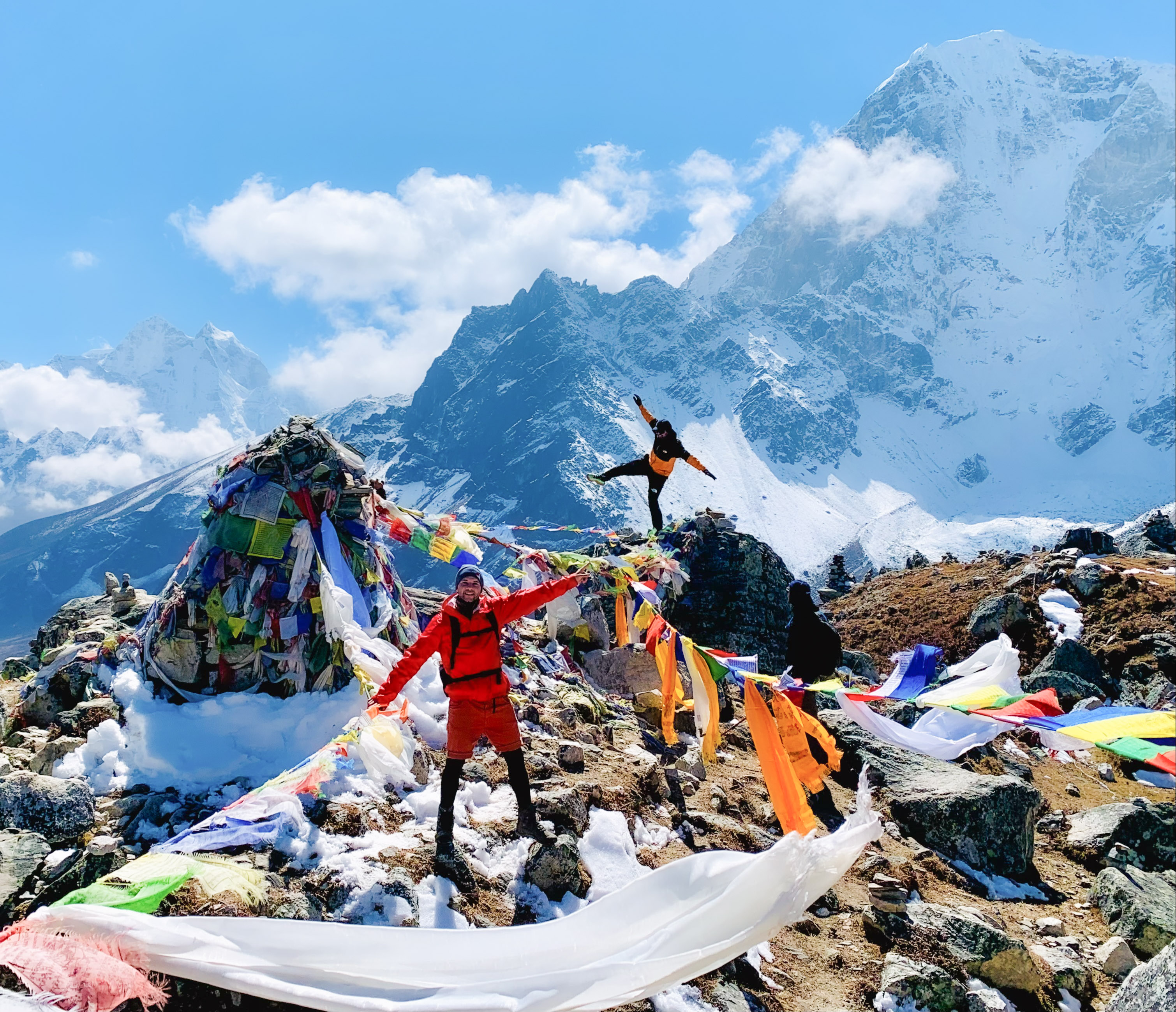
- Tengboche Monastery is the spiritual center of the Khumbu Valley. You can see prayer wheels, prayer flags and mani stones while hiking through the mountains.
- Discover the Sherpa culture and Buddhism.
- In Namche Bazaar, you should also visit the Sherpa Culture Museum as well as the Everest Photo Gallery.
- Get warmly welcomed during your stay at the mountain teahouse run by local people.
- Visit Thame, a historic Sherpa village known for its strong mountaineering tradition and its association with renowned Sherpa climbers.
Altitude and Acclimatization on the Everest Three Passes Trek
Our plan to ensure proper acclimatization includes the following measures:
- Acclimatization days in Namche Bazaar, Dingboche, and Gokyo.
- Gradual altitude gain throughout the itinerary.
- Acclimatization hikes to the Everest View Hotel, Nangkartshang Peak, and Gokyo Ri.
- A flexible itinerary that can be adjusted according to weather, trail conditions, and the health of trekkers.
- Regular monitoring for symptoms of Acute Mountain Sickness (AMS) by experienced guides.
- Encouragement to maintain a comfortable pace, stay properly hydrated, eat regular meals, and communicate any symptoms or health concerns to the trekking team.
Permits Required for the Everest Three Passes Trek
1. Sagarmatha National Park Entry Permit
2. Khumbu Pasang Lhamu Rural Municipality Permit
Travel Insurance for Everest Three Passes Trek
The following must be included in travel insurance:
- High-altitude trekking insurance up to a minimum of 5,600 meters.
- Helicopter evacuation in case of emergency.
- Hospitalization and medical treatment.
- Coverage for Acute Mountain Sickness (AMS).
- Travel interruption and trip cancellation.
- Flight delays and missed connections
- Baggage that is lost, damaged, delayed or has been delayed.
- Personal accident coverage.
- Travel insurance policies can be carried in both digital and printed form.
Everest Three Passes Trekking Difficulty
While no prior technical mountaineering or climbing experience is necessary, a good level of physical fitness, past trekking experience and mental resolve are required to successfully complete the journey.
- Difficulty: Challenging or strenuous.
- Daily walking duration is approximately 5-8 hours.
- Highest elevation: Kala Patthar (5,545m).
- Crosses Kongma La (5.535m), Cho La (5.330m) and Renjo La (5360m).
- This route is steep and involves rocky trails, glacial moraines, loose scree and snow or ice.
- This requires several days of hiking above 5,000 metres.
- Trekkers who have good physical fitness and experience in multi-day hikes are recommended.
- Although no technical climbing skills are required, proper preparation and equipment are recommended.
Why Trek with Nepalaya Treks?
Nepalaya Treks offers you:
- Experienced, licensed and government-licensed trekking guides.
- Local support staff that are friendly and knowledgeable.
- We will ensure that all your logistical affairs are sorted out on your trip.
- No surprises from us – we always remain open and clear.
- Service to you around the clock before and during your trip.
- Excellent customer service is our specialty.
- Professionally trained and insured porters.
- This is what makes your trip to the Himalayas so memorable and safe.
Why Should You Consider Everest Three Passes Trek
This itinerary features:
- Well-balanced walking hours.
- Resting hours after exhausting hours of walking.
- Proper timing to ensure that you do not feel fatigued unnecessarily.
- Efficient planning of your trek will help you enjoy it.
- You should have comfortable stays during your trek.
- This itinerary is flexible and can be changed depending on the weather.
- Perfect plan for experienced hikers.
Safety of the Everest Three Passes Trek
These are some of the safety measures that are taken into consideration while conducting the Everest Three Passes trek.
- Daily assessment of the weather and trail conditions.
- Flexible decision-making based on the mountain conditions.
- The guides are equipped with wilderness first aid training.
- It becomes necessary to communicate with local rescue teams.
- If anyone gets ill or hurt, immediate help is needed.
- Before challenging trek days, safety briefings are recommended.
- Priority is given to the health of all trekkers.
Responsible Tourism
Some of the responsible tour behaviors include:
- Helping local teahouses and other small business enterprises.
- Showing respect to local customs and traditions.
- Minimize the use of single-use plastics whenever possible.
- Reusing waste items while traveling.
- Saving water and energy in hilly areas.
- Protection of local flora and fauna.
- Use of the "Leave No Trace" policy.
- Sustainable tourism for generations to come.
Group Size
The following are the group combinations that are available:
- Small groups offer a more personalized experience.
- Improved interaction with the guides during the entire trek.
- All participants can enjoy a comfortable pace of walking.
- Coordination of accommodation and meals is easier.
- For larger groups, additional assistant guides can be arranged.
- Join scheduled departures with solo travelers.
Private Departure Available
Private departures include:
- Travel dates can be flexible based on your schedule.
- Exclusive guide and porter service.
- Trekking experience tailored to your group.
- Increased flexibility in daily walking pace
- Couples, families and corporate groups can all benefit from this product.
- Arrangements can be made to suit your needs.
Equipment Rental Information
Common rental equipment includes:
- Down jackets
- Sleeping bags for all four seasons.
- Trekking poles.
- Waterproof duffel bags
- Gaiters.
- Microspikes are available (if the season demands).
- You could even pack extra gear as suggested by your guide.
It is essential to ensure that the equipment hired is in proper working order before setting off on your journey.
Trip Highlights
- Follow sections of the historic Himalayan trade route once used by Tibetan merchants between Nepal and Tibet
- Trek through Sagarmatha National Park, a UNESCO World Heritage Site renowned for its forests, glaciers, wildlife, and iconic suspension bridges
- Enjoy breathtaking views of Everest, Lhotse, Makalu, Cho Oyu, Ama Dablam, Nuptse, Pumori, Thamserku, Kangtega, Baruntse, and Island Peak
- Immerse yourself in authentic Sherpa culture, Buddhist traditions, and warm mountain hospitality
- Trek through picturesque Sherpa villages, including Phakding, Namche Bazaar, Tengboche, Pangboche, Dingboche, Chhukung, Gokyo, Thame, and Lungden
- Visit Tengboche Monastery, the largest monastery in the Khumbu, and attend a traditional Buddhist Puja ceremony (schedule permitting)
- Experience the vibrant atmosphere of Namche Bazaar, the gateway to the Everest region
- Explore the turquoise Gokyo Lakes and the Ngozumpa Glacier, the longest glacier in Nepal
- Hike to Gokyo Ri (5,357m) for panoramic views of Everest, Lhotse, Makalu, Cho Oyu, and the Gokyo Lakes
- Witness a spectacular Himalayan sunrise from Kala Patthar (5,545m)
- Reach Everest Base Camp (5,364m), the gateway to the world's highest mountain.
- Conquer the legendary Everest Three Passes: Kongma La (5,535m), Cho La (5,420m), and Renjo La (5,360m)
Itinerary
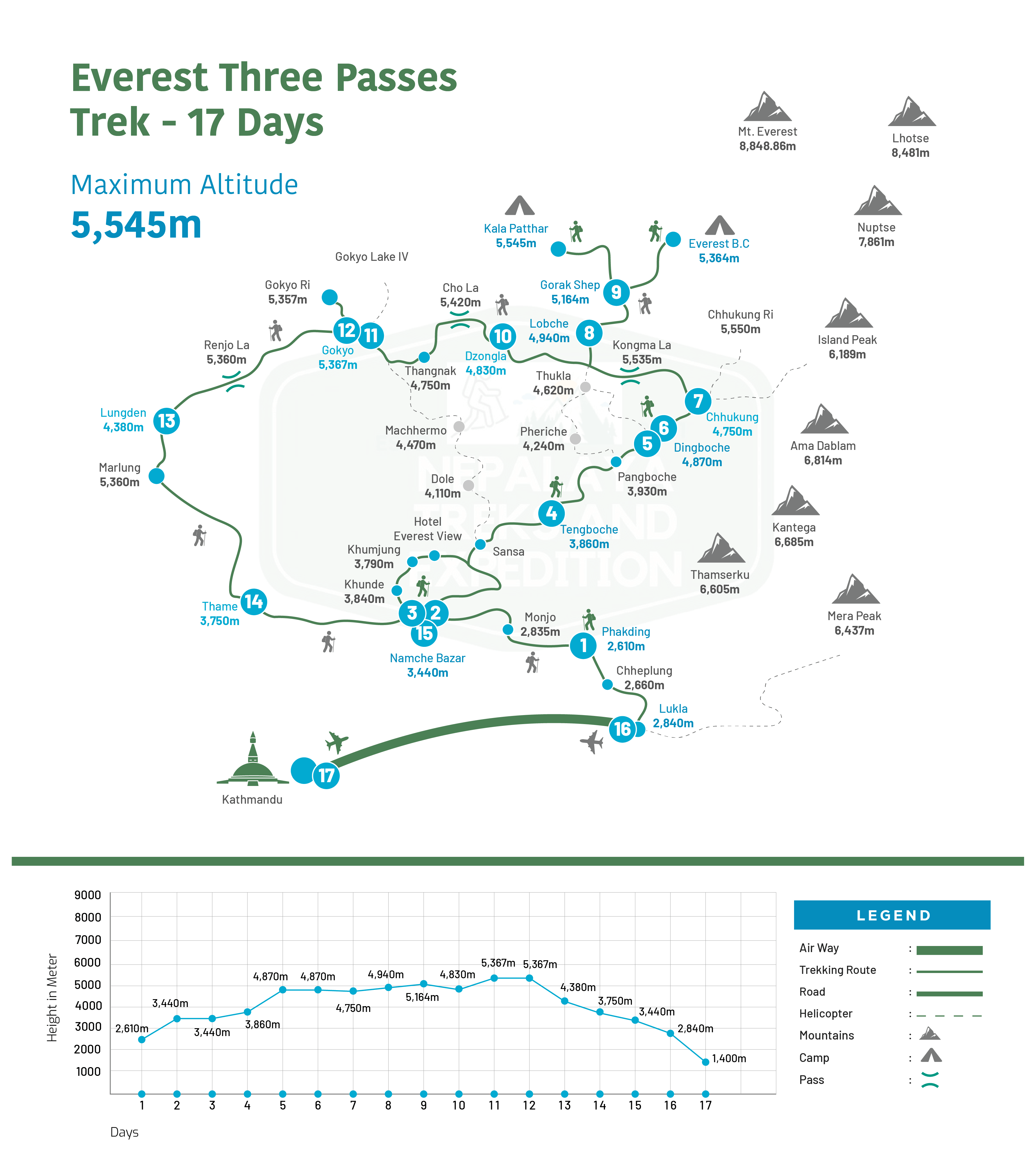
Day 1: Fly from Kathmandu (1,400m) to Lukla (2,840m), Trek to Phakding (2,610m)
After your landing at the Tenzing-Hillary Airport, you will be introduced to your trekking guides and teams who will take you on your first trip to the heart of the Khumbu region. You will travel by the trail that winds down through small Sherpa villages and crosses over the suspension bridges adorned with prayer flags, mani walls, prayer wheels, and small shrines. Along the way to Chheplung and Ghat villages, you will get your first view of the majestic Kusum Kanguru mountain. Then you continue traveling to the village of Phakding by following the Dudh Koshi River and spend the first night in a teahouse.
- Max Elevation: 2,840 meters (9,318 feet)
- Travel Distance: Flight: Approximately 138 kilometers, Trek: Approximately 8 kilometers
- Travel Hours: 35-minute flight | 3 to 4 hours trek
- Accommodation: Mountain teahouse
- Meals Included: Dinner
Day 2: Trek from Phakding (2,610m) to Namche Bazaar (3,440m)
Day 3: Acclimatization Day in Namche Bazaar (3,440m) | Hike: 3 to 4 Hours
Day 4: Trek from Namche Bazaar (3,440m) to Tengboche (3,870m) | Trek: 5 Hours
Day 5: Trek from Tengboche (3,870m) to Dingboche (4,410m) | Trek: 5 Hours
Day 6: Acclimatization Day in Dingboche (4,410m) | Optional Hike to Nangkartshang Peak (5,083m)
Day 7: Hike from Dingboche (4,410m) to Chhukung (4,730m) | Hike Duration: 3 Hours
Day 8: Cross Kongma La Pass (5,535m) and Trek to Lobuche (4,910m) | Trek: 7 to 8 Hours
Day 9: Walk from Lobuche (4,910 m) to Everest Base Camp (5,364 m), Back to Gorak Shep (5,164 m)
Day 10: Kala Patthar (5,545m) Climb to Dzongla (4,830m) | Duration: 5 to 6 Hours
Day 11: Cross Cho La Pass (5,330m) and Trek to Gokyo (4,790m) | Trek: 7 to 8 Hours
Day 12: Acclimatization Day in Gokyo (4,790m) | Hike to Gokyo Ri (5,357m)
Day 13: Cross Renjo La Pass (5,360m) and Trek to Lungden (4,380m) | Trek: 7 to 8 Hours
Day 14: Trek from Lungden (4,380m) to Thame (3,820m) | Trek: 4 to 5 Hours
Day 15: Trek from Thame (3,820m) to Namche Bazaar (3,440m) | Trek: 4 to 5 Hours
Day 16: Trek from Namche Bazaar (3,440 m) to Lukla (2,840 m) | Walk: 7 to 8 hours
Day 17: Fly from Lukla (2,840m) to Kathmandu (1,400m) | Flight: Approximately 35 Minutes
Route Map
Inclusion / Exclusion
Inclusion
- Private vehicles pick up and drop off at the airport.
- Two nights' accommodation in Kathmandu with breakfast, including one night before and one night after the trek.
- Taxes included for round-trip flights from Kathmandu to Lukla or Ramechhap-Lukla in peak season.
- All ground transportation is listed in the itinerary.
- Teahouses provide comfortable accommodation for the entire trek.
- Three meals per day during the trek, including breakfast, lunch, and dinner.
- Seasonal fresh fruit is served after dinner during the trek.
- Government-licensed English-speaking trekking guide.
- One porter for every two trekkers (maximum 20 kg combined luggage).
- Guide and porter salary, insurance, accommodation, meals, transportation, and equipment.
- Sagarmatha National Park Entry Permit.
- Khumbu Pasang Lhamu Rural Municipality Permit.
- A comprehensive first aid kit is carried by your guide.
- Pulse oximeter for regular oxygen saturation monitoring.
- Trek route map and official trek completion certificate.
- All applicable government taxes and company service charges.
Exclusion
- International airfare to and from Nepal.
- Nepal entry visa fees.
- Travel insurance that covers high-altitude trekking, helicopter evacuation and other activities.
- Personal trekking clothing, equipment and gear.
- Enjoy lunch and dinner in Kathmandu.
- Personal expenses include snacks, soft drinks and alcoholic beverages. Also included are bottled water, bakery products, desserts, tea, coffee or other hot beverages.
- Teahouses offer hot showers, Wi Fi, charging stations, and laundry service.
- Guides, porters and trekking staff are all entitled to tips.
- Medical expenses that are not covered by insurance
- Flight delays, cancellations or unforeseeable circumstances can result in additional accommodation and transportation costs.
- Expenses that arise from events such as natural disasters, political unrest or strikes.
- All services that are not listed in the Cost Includes section.
Check List
While most of the necessary items can easily be rented in Kathmandu, we advise you to carry your properly fitted clothes, trekking boots, and some other common items to ensure you have complete comfort during the trek.
Clothes
- Moisture-wicking base layer tops (2-3)
- Bottoms with moisture-wicking base layers (2)
- Fleece Jacket/Insulated Jacket (lightweight)
- A heavy down jacket which is suitable in sub-zero temperatures
- Shell jacket, which is waterproof and windproof
- Waterproof trekking pants
- Trekking pants (2)
- Thermal Leggings
- Lightweight trekking shirts (2-3)
- Warm sweaters/mid-layer
- Comfortable clothes for evening
- Underwear (5-7)
- Sports bra(if needed)
- Warm trekking socks (4-5)
- Liner socks
- Gaiters are advisable if there are snows
Footwear
- Waterproof and durable trekking boots with ankle support
- Lightweight sandals/camp shoes
- Warm slippers
- Microspikes are advisable in winter conditions or when there is a thick layer of ice.
Headwear and hand protection
- Warm wool or fleece hat
- Sun Hat or Cap
- Neck gaiter or buff
- Balaclava (recommended on cold mornings).
- Insulated gloves for warmth
- Lightweight inner gloves
Trekking Equipment
- Sleeping bag for four seasons (rated at least to -15degC).
- Trekking poles
- Backpack (30-40 Liters) for everyday essentials
- Waterproof duffel bag carried by porter
- Backpack rain cover
- Dry bags or waterproof stuff bags
Personal Essentials
- Sunglasses that protect against UV
- Sunscreen (SPF50+)
- Lip Balm with SPF
- Headlamp with Extra Batteries
- Reusable Water Bottles (2 Liters Total Capacity)
- A thermos flask is recommended.
- Filter bottles or tablets for water purification
- Quick-drying towel
- Wet wipes
- Hand sanitizer
- Toilet paper
- Toothbrushes and toothpaste
- Soaps and shampoo
- Nail clipper
- Moisturizer
First Aid and Health
- Prescription medications for personal use
- Basic first aid supplies
- Diamox (after consulting your doctor)
- Pain relief medications
- Blister treatment
- Bandages and antiseptic lotion
- Cold and flu medications
- Oral rehydration Salts
- Electrolyte tablets
- Insect repellent for lower altitudes
Electronics
- Mobile phone
- Camera
- Power Bank (10,000-20000 mAh Recommended)
- Charging cables
- Universal travel adapter
- Memory cards and spare batteries for cameras
Travel Documents
- Valid passport
- Nepal Visa (if applicable)
- Documents for Travel Insurance
- Passport-sized photographs
- Tickets for Flight
- Emergency Contact Information
- Money in Nepali Rupee
Other Items to Bring
- Binoculars
- Diary and Pen
- Travelling Games/Playing Cards
- Favourite Snacks or Energy Bars
- Book/e-reader
- Small Sewing Kit
- Zip-lock bags are a good way of keeping things organized
- Rental of Equipment in Kathmandu
- Down Jackets
- Seasonal Sleeping Bags
- Trekking Poles
- Waterproof Duffels
- Gaiters
- Micro Spikes
Trip FAQs
-
1. How difficult is the Everest Three Passes Trek?
Yes, the Everest Three Passes Trek is one of the hardest treks in Nepal. It is designed for those trekkers who have great physical strength as well as past experience in trekking. However, though there will be no need for technical climbing, you should have the endurance to face it. -
2. Do I need prior experience with trekking?
Prior experience of trekking at high altitudes is preferred. This trek is not a technical one; however, passing through three mountain passes at more than 5,300m will require confidence and endurance. -
3. What is the highest point of the Everest Three Passes Trek?
The highest point of the trekking route is Kala Patthar (5,545 m). Kongma La Pass (5,535 m) is the highest mountain pass that you will cross during your trek. -
4. Is altitude sickness a possible concern on the trek?
Yes. There is a chance of Acute Mountain Sickness. We have carefully planned acclimatization days, and our guides are constantly monitoring trekkers. By staying hydrated, keeping a steady pace and listening to your guide, you can greatly reduce the risks. -
5. What permits are needed for the Everest Three Passes Trekking?
To go on this trek, you require two key permits. These permits include:- Sagarmatha National Park Entrance Permit
- Khumbu Pasang Lhamu Permit for Rural Municipality
This is usually done by the trekking company prior to the start of your trek. -
6. What kind of accommodation can I expect during my trek?
Traditional Himalayan teahouses offer comfortable rooms for twin sharing. The majority of teahouses have only the basic bedding, with communal bathrooms. Despite the fact that the facilities may be less luxurious at higher altitudes, the hospitality of Sherpa families will ensure that each night becomes unforgettable. -
7. Which mountains will I see on the Three Passes Trek of Everest?
During this trek, you will be able to observe Mount Everest, Lhotse, and Makalu, along with all other mountain peaks that surround them, such as Nuptse, Pumori, Baruntse, Island Peak, Thamserku, and Kangtega. -
8. How many hours will I hike in a day?
On average, the time spent hiking every day is approximately 5 to 8 hours depending on the level of the terrain and altitude. They also provide beautiful mountain sights. -
9. Why should one take the Everest Three Passes Trek instead of the Everest Base Camp Trek?
The Everest Three Passes Trek is a more comprehensive Himalayan adventure compared to the standard Everest Base Camp Trek. The Everest Three Passes Trek includes the Everest Base Camp, Kala Patthar and Gokyo Lakes. It also includes Gokyo Ri and the legendary mountain pass of Kongma La. This circular route explores quieter valleys and remote Sherpa settlements as well as less-crowded trails. It is the ultimate Everest trekking experience. -
10. What is the duration of the Three Passes Trek?
The Everest Three Passes Trek typically takes around 17 to 20 days, depending on the itinerary, acclimatization schedule, weather, and trail conditions. This period will give sufficient time to acclimatize well, pass through the challenging passes successfully and visit some important destinations such as the Everest Base Camp and Kala Patthar. -
11. When is the best time of year to trek the Everest Three Passes?
Spring (March to May) and autumn (September-November) are the best seasons. The best months to visit are spring (March-May) and autumn (September-November).
All Inclusive Cost
USD 2655
Per Person
BOOK NOW QUICK ENQUIRY- Best Price Guarantee
- Hassle-Free Booking
- Team of highly experienced Experts
You may also like !!
Our Best Selling Packages You May Like.