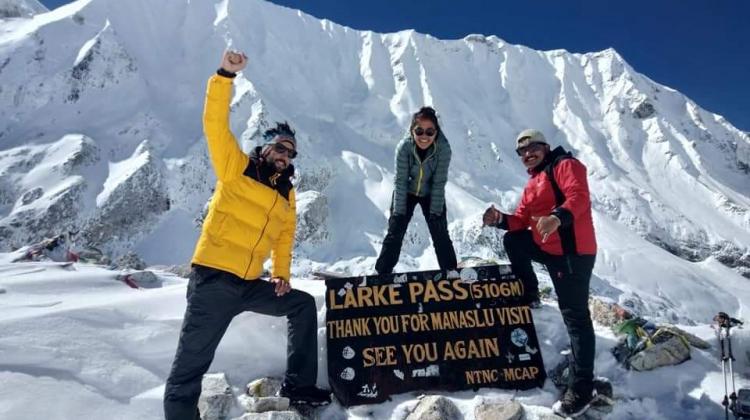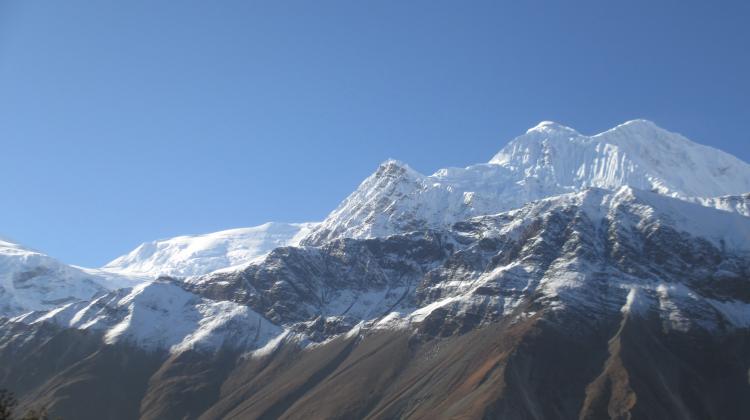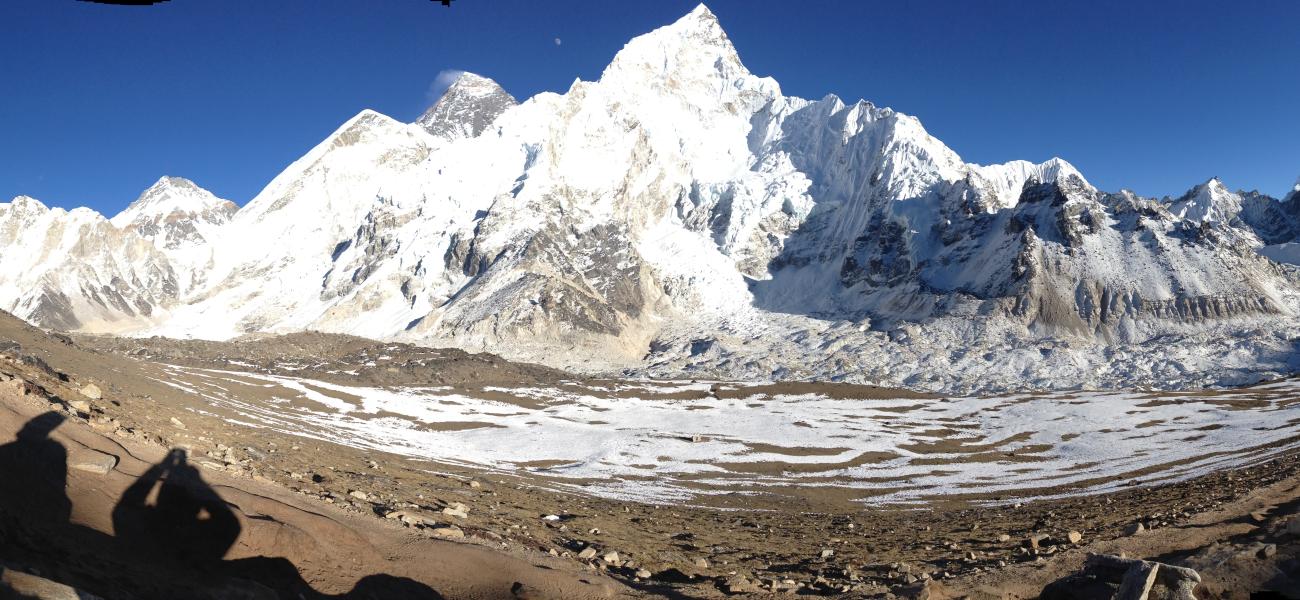
Everest Base Camp Yoga Trek
Overview
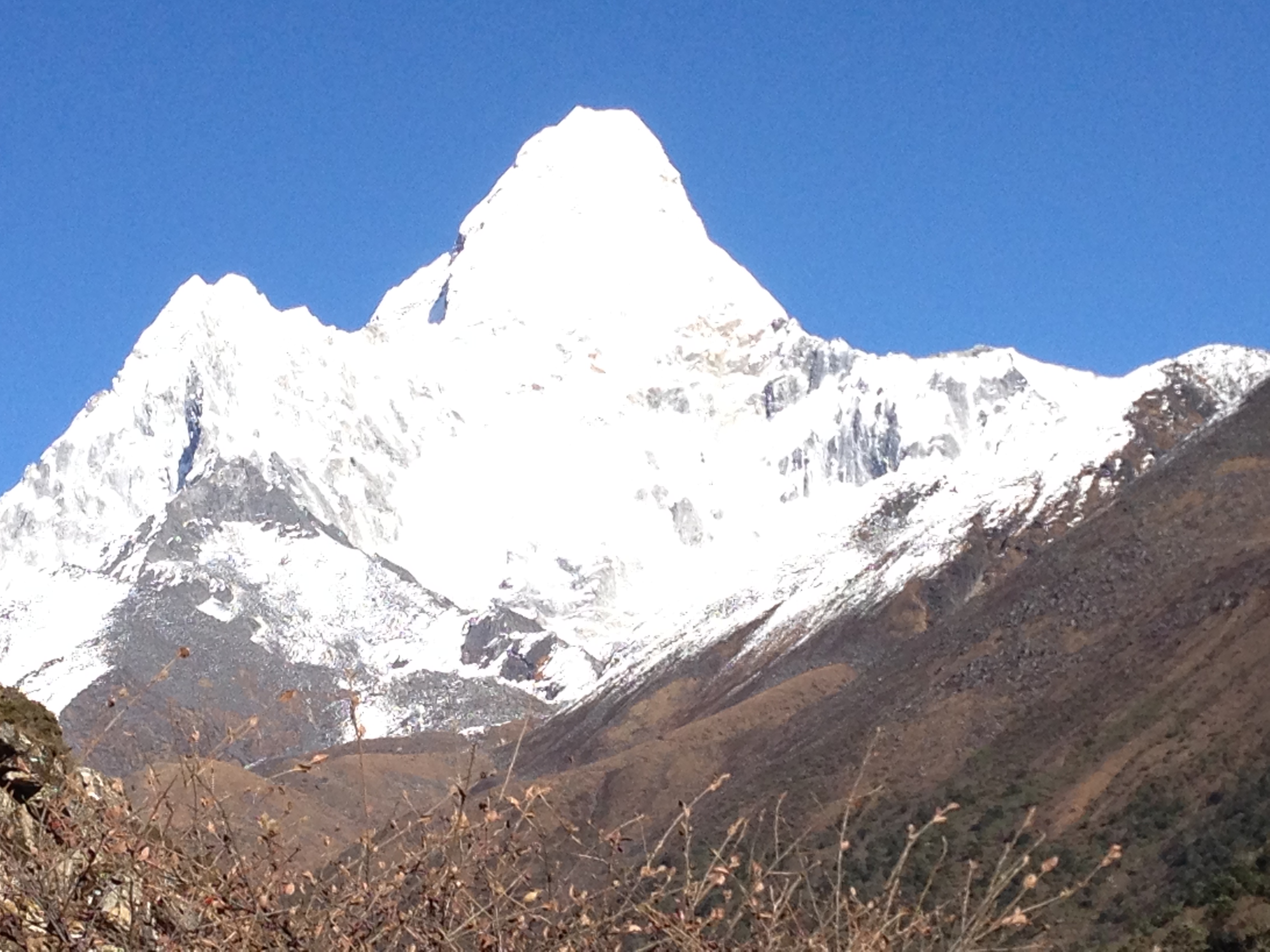
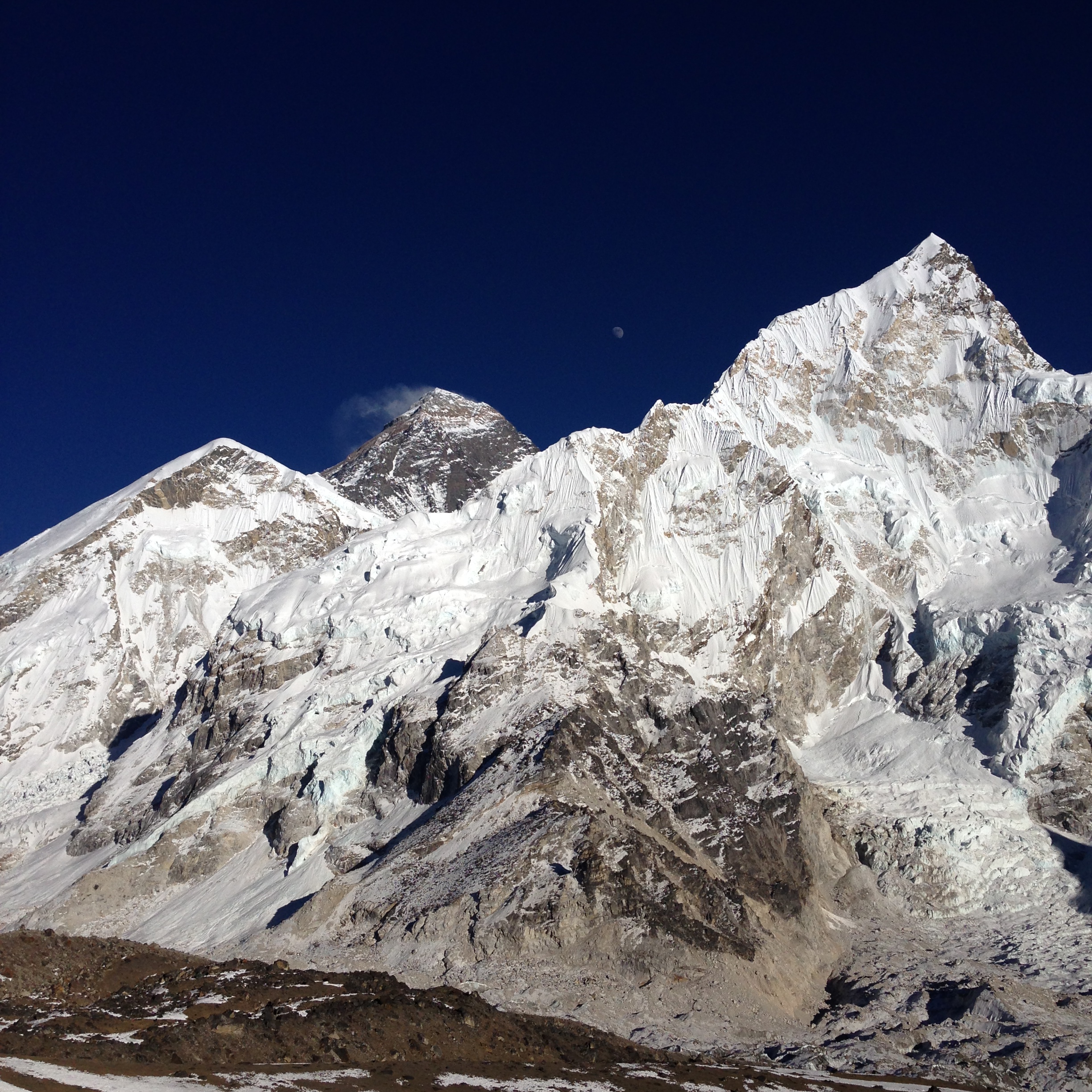
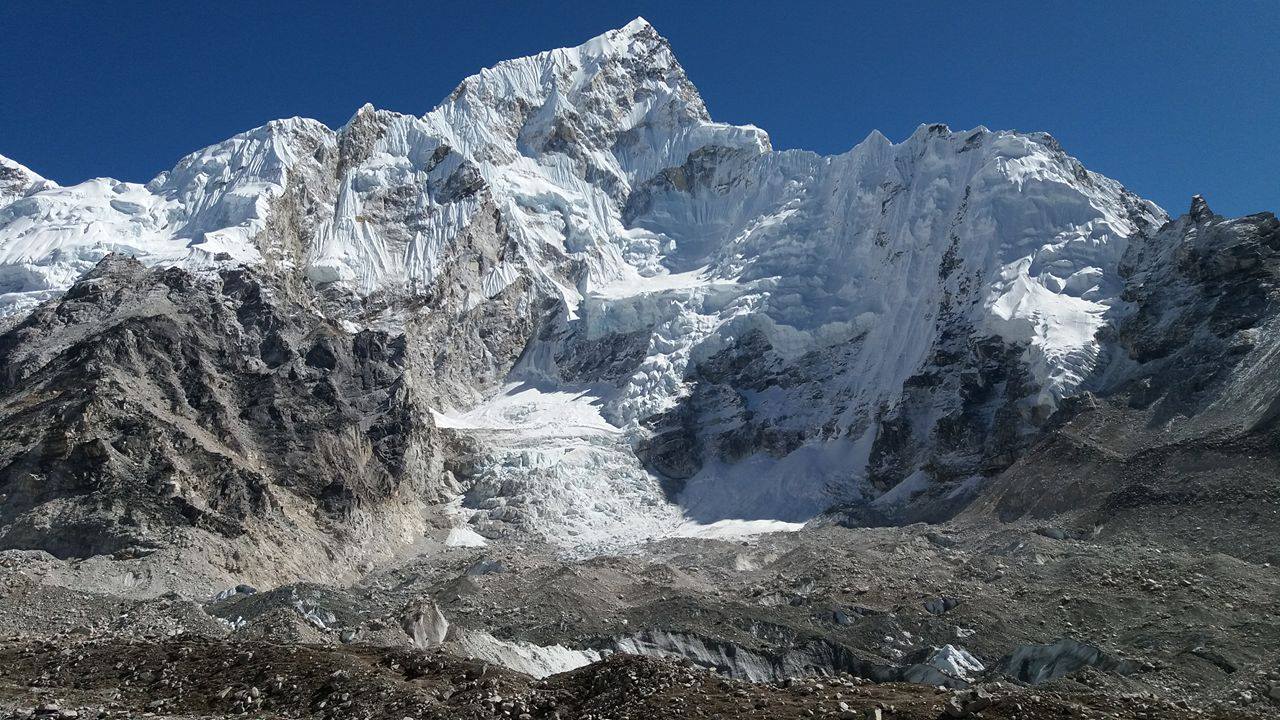
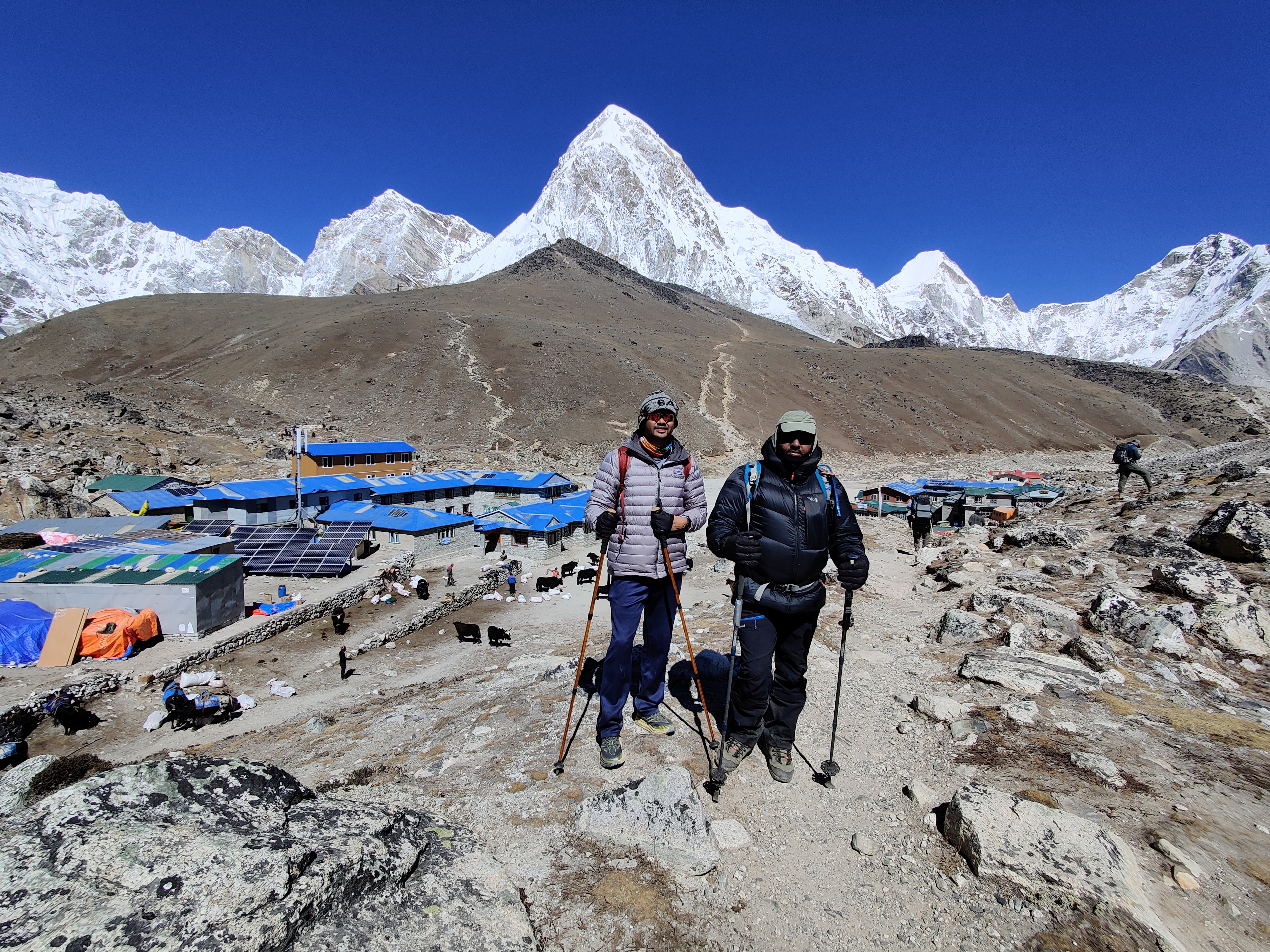
The Everest Base Camp Yoga Trek combines the classic Everest Base Camp trekking experience with daily yoga and meditation sessions, creating a unique journey that nurtures both the body and mind. The 14-day trip goes along the famous Everest trail and through the heart of Khumbu valley giving you a chance to admire the beauty of the Himalayas while keeping your balance and sanity. The Everest Base Camp Yoga Trek passes through charming Sherpa villages, ancient Tibetan Buddhist monasteries, pine and rhododendron forests, and eventually reaches Everest Base Camp at 5,364 meters. Yoga, stretching, meditation, and breathing exercises can support relaxation, flexibility, recovery, and mindfulness during the trek, while proper acclimatization and gradual ascent remain essential at high altitude. In addition to that, you can get a morning hike to the top of Kala Patthar (5,545m) - the highest viewpoint where one can see the panorama of Himalayan peaks including the majestic Everest, Lhotse, Nuptse, Pumori, Ama Dablam and many others.
Additional Highlights of the Everest Base Camp Yoga Trek – 14 Days
Besides reaching Everest Base Camp and witnessing the breathtaking Himalayan landscapes, this trek offers a unique combination of adventure, wellness, culture, and nature. Yoga and meditation sessions, authentic Sherpa hospitality, and unforgettable mountain scenery make this journey much more than a traditional Everest trek.
- Begin each day with yoga in the Himalayas. Practice yoga, stretching, breathing exercises, and meditation in the peaceful mountain environment, helping you prepare both physically and mentally for the day's trek.
- Practice yoga at scenic mountain locations. Enjoy guided yoga and meditation sessions surrounded by spectacular Himalayan landscapes, creating a truly unique wellness experience.
- Experience authentic Sherpa culture. Stay in family-run teahouses, interact with local communities, and learn about Sherpa traditions, hospitality, and daily life while enjoying traditional Nepali cuisine.
- Trek through Sagarmatha National Park. Explore one of Nepal's most spectacular UNESCO World Heritage Sites, known for its glaciers, rivers, alpine forests, unique wildlife, and some of the world's highest mountains.
- Discover the spiritual heritage of the Khumbu region. Pass ancient monasteries, colorful prayer flags, mani stones, chortens, and prayer wheels while gaining insight into Tibetan Buddhist traditions.
- Witness the changing Himalayan landscapes. Experience an incredible transition from lush pine and rhododendron forests to alpine meadows, rocky glacial terrain, and towering snow-covered peaks.
- Explore the vibrant town of Namche Bazaar. Visit the gateway to Everest, where you can browse local markets, relax in cafés and bakeries, explore museums, and enjoy panoramic mountain views.
- Connect with fellow trekkers from around the world. Spend your evenings in cozy mountain teahouses, sharing stories and experiences with travelers from different countries.
- Enjoy unforgettable Himalayan nights. Stay in peaceful mountain villages far from city lights, where clear skies often provide spectacular views of countless stars above the Everest region.
What to Expect on Everest Base Camp Yoga Trek?
It is full of adventure, yoga practice, and culture experience. While traveling on the famous Everest Base Camp Yoga Trek route, you will learn yoga practice, meditation, and breath control techniques, which would allow you to unwind yourself after every day of tough trekking. You will walk through Sherpa villages, lush forests, glaciers and valleys, and finally reach the base camp of Mount Everest at an elevation of 5,364 meters. This is a difficult high-altitude trek, but it is designed to include days for acclimatization and gradually ascending to the required altitude.
- Pass through various terrain types including pine forest, rhododendron forest, suspension bridge, mountain trail, glacial moraine and even alpine terrain while trekking towards Everest Base Camp.
- Prepare for a walking time of five to eight hours per trekking day. Physical fitness and preparation before the trip make the journey easier for you.
- Practice yoga, meditation, and breathing while trekking for flexibility and quick recovery without feeling tired and losing focus.
- Visit Sherpa villages including Namche Bazaar, Tengboche, Dingboche and Lobuche to see what they are all about.
- Enjoy your stay in comfortable teahouses which provide you with a decent place to live, warm meals, cozy rooms, and local residents.
- Enjoy changing landscapes from green forests to glaciers among the mighty Himalayas.
- Make it to the Everest Base Camp located at an altitude of 5,364 meters and ascend Kala Patthar at 5,545 meters and enjoy breathtaking views of Mount Everest, Lhotse, Nuptse, Ama Dablam and other giants of the Himalayas.
The Best Seasons for the Everest Base Camp Yoga Trek
It is highly recommended to do the Everest Base Camp Yoga Trek in the spring season from March till May and the autumn season from September till November. The weather during these months is pleasant, temperatures are favorable, the visibility is great and the conditions for trekking and yoga practice outdoors are wonderful. These seasons are the most favorable for trekkers who visit the area of the Everest as there is a possibility to see the impressive mountain ranges in pleasant weather conditions. However, it is possible to make the Everest Base Camp Yoga Trek in winter and monsoon seasons.
1. Spring Season (March to May)
One of the best seasons to make the Everest Base Camp Yoga Trek is the spring season when the weather is stable, the temperature is favorable and the slopes are decorated with rhododendrons. Due to the clear sky, there are breathtaking views of Mt. Everest and other Himalayan mountains during the entire course of the trek. With comfortable temperatures, you can find perfect weather conditions for doing yoga and meditation in the serene mountain setting.
2. Autumn Season (September to November)
The autumn season is believed to be the best season for the Everest Base Camp Yoga Trek due to the stable weather and excellent visibility of mountains. The skies are clear after the monsoon showers and hence offer wonderful views of the peak of Mt. Everest and other neighboring peaks. With dry paths, cool temperatures, and mountain air, trekking is easy along with yoga and meditation.
3. Winter Season (December – February)
A quiet trekking season with low numbers of tourists in the Everest region. There are magnificent snow-covered landscapes all across the Everest region and clear views of the mountains, which make it one of the best seasons for photography. But cold and frosty weather can occur at higher altitudes with temperatures well under zero, and there is occasional snowfall that can affect the trail. Therefore, it is a good idea to prepare yourself properly with the necessary clothing and trekking gears before starting your trekking journey.
4. Monsoon Season (June – August)
Monsoon season brings lush greenery, flowers, river streams, and magnificent waterfalls to the lower part of the Everest region. But heavy rains cause many parts of the trail to be slippery and muddy. Visibility of the mountains is low due to thick fog, and flights to and from Lukla may have some weather delays. Despite the possibility of completing the trek, the monsoon is not considered the best season to visit Everest Base Camp.
Accommodation and Food during the 14 Days Everest Base Camp Yoga Trek
The accommodation and food during the 14-day Everest Base Camp Yoga Trek are very well organized in order to make sure that you remain comfortable, energetic, and refreshed through the duration of your Himalayan journey. Prior to and following the trek, you will be accommodated at comfortable hotels in Kathmandu, but during the trek you get the warm hospitality of traditional tea houses run by Sherpa families.
- Freshly prepared meals provide the energy needed for trekking, while comfortable dining halls and yoga sessions help you relax and recover after each day's hike.
- Relax in comfortable hotel rooms in Kathmandu before and after the hike, thus getting an opportunity to rest after your flight.
- Live in traditional Sherpa teahouses along the way through the Everest region, where you will have simple but comfortable rooms to sleep in after your daily hikes and get an authentic mountain experience.
- Rest in the friendly atmosphere of teahouse dining halls at night when you will be able to enjoy homemade food, warm yourselves near the stove, make easy chats with other trekkers and relax before the next day's hiking.
- Start your hiking day with a hearty breakfast, consisting of porridge, eggs, Tibetan bread, pancakes, toast, muesli, chapati and hot drinks. You will usually be served nutritious dinners and lunches, consisting of dal bhat, fried rice, noodles, pasta, soups, potatoes, momos, curries, vegetables and other food items prepared in teahouses, which will give you energy for hiking at high altitudes.
- Warm up with different kinds of hot drinks that will be offered at teahouses. You may try black tea, milk tea, ginger tea, lemon tea, coffee, hot chocolate and herbal teas that are especially helpful in cold mountains.
- Drink boiled or filtered water that you may buy at teahouses. It is recommended to carry your own water bottle and purifying tablets or portable water filters.
Note that as you get higher, teahouse menus become simpler, as it is more difficult to deliver supplies to remote Himalayan villages. Nonetheless, the food served will still remain fresh and nutritious.
Cultural Experiences During the Everest Base Camp Yoga Trek
- The Everest Base Camp Yoga Trek does not just provide a trip to the base of the world’s tallest peak; it also offers the chance to connect with the vibrant culture and spiritual practices of the Khumbu Valley.
- Yoga and meditation complement the Himalayan environment by promoting relaxation, mindfulness, and physical recovery throughout the trek.
- Visit traditional Sherpa villages like Phakding, Namche Bazaar, Tengboche, Pangboche, Dingboche, Lobuche and Gorak Shep, where you will immerse yourself in the world of Himalayan culture, architecture and local families' hospitality.
- Learn more about the Sherpa community, their unique traditions, mountaineering background, Buddhist beliefs, their seasonal festivals and lifestyle, which was formed over years of living in the highest parts of the planet.
- Pass by mani stones with beautiful carvings, colored prayer flags, old chortens, prayer wheels and other monuments that reveal the spiritual heritage of Tibetan Buddhism in the Everest region.
- You can visit the Tengboche Monastery, which is considered to be the biggest and most important Buddhist monastery in the Khumbu region, where you can see prayer services being held by the monks.
- Try out the teahouses operated by the local people to get to know the genuine hospitality of the Sherpas and enjoy the tasty local cuisine prepared by them.
- Some of the dishes that you can try include dal bhat, Tibetan bread, thukpa, momos, noodles, potatoes, soups, and lots of other dishes that have been made using locally available ingredients.
- Visit the town of Namche Bazaar, which is famous for its Sherpa culture along with its modern trekking facilities, local markets, bakeries, museums, and history related to mountaineering.
- Meet locals, porters, your guides and other trekkers on your way and see how the mountain communities manage to preserve their traditions in spite of development and tourism.
- Notice the bond that exists between Buddhism, nature, and the Sherpa people’s day-to-day existence in the Everest region, where mountain and animal respect is still a very big part of the local culture.
- Take note of the harmonious relationship that exists between yoga, meditation, and the natural beauty of the Himalayas.
Altitude and Acclimatization on the Everest Base Camp Yoga Trek
The highest point of the trek is Kala Patthar (5,545 meters), while Everest Base Camp is situated at 5,364 meters. At these high altitudes, oxygen levels are significantly lower than at sea level, making proper acclimatization essential for a safe and enjoyable trek. The itinerary is designed with gradual ascents and two acclimatization days in Namche Bazaar and Dingboche, along with yoga, meditation, and breathing sessions.
- Reach the highest point of your adventure at Kala Patthar (5,545 meters), one of the most spectacular viewpoints in the Everest region. As oxygen levels decrease with increasing altitude, proper acclimatization is an essential part of the trek.
- Follow an itinerary that gradually increases your sleeping altitude and includes two acclimatization days in Namche Bazaar and Dingboche. This gradual ascent gives your body time to adjust to the changing altitude.
- Take acclimatization hikes based on the "climb high, sleep low" principle. These hikes allow your body to gradually adapt to the increasing altitude and can help reduce the risk of altitude-related problems.
- Receive continuous support from your experienced trekking guide, who will monitor your health and overall condition and watch for early signs of altitude sickness.
- Your guide may also use a pulse oximeter when necessary to monitor your blood oxygen saturation and heart rate as you ascend to higher altitudes.
- If you experience symptoms such as headache, dizziness, nausea, vomiting, extreme tiredness, loss of appetite, or shortness of breath, inform your guide immediately. Depending on your condition, your guide will recommend the appropriate steps to help you acclimatize safely.
- Support proper acclimatization by staying hydrated, eating well, maintaining a steady pace, getting enough rest, and following your guide's recommendations.
- Listen to your body throughout the journey. Reporting even mild symptoms or discomfort allows your guide to respond quickly and help you continue your trek safely.
Trekking Difficulty of the Everest Base Camp Yoga Trek
The Everest Base Camp Yoga Trek is considered a moderately challenging high-altitude trek. Although the route does not require technical mountaineering skills, it involves several days of hiking at altitudes above 3,000 meters, with the highest point reaching 5,545 meters at Kala Patthar. The trek can be physically demanding due to long hiking days, steep ascents and descents, rocky terrain, and reduced oxygen levels. With proper preparation, gradual acclimatization, and an appropriate pace, physically fit beginners who are prepared for high-altitude conditions can complete the trek.
- The trek is suitable for physically active beginners as well as experienced hikers who are prepared for several consecutive days of trekking in the Himalayas.
- Daily hiking hours generally range from 5 to 8 hours, depending on trail conditions, weather, altitude, and the pace of the trekking group. The most challenging days are typically the hikes to Everest Base Camp and Kala Patthar.
- Experience a variety of terrain throughout the trek, including suspension bridges, forest trails, stone steps, rocky mountain paths, glaciers, moraines, and alpine valleys.
- Be prepared for the challenges of high-altitude trekking. As altitude increases, thinner air and lower oxygen levels can make even familiar hiking activities more physically demanding.
- No technical climbing equipment is required, but appropriate high-altitude trekking clothing and gear are essential for comfort and safety.
- Prepare for the trek in advance to make your journey more comfortable and enjoyable. You can improve your fitness by hiking, climbing stairs, jogging, cycling, swimming, strength training, and other cardiovascular exercises.
- Incorporating yoga, stretching, meditation, and breathing exercises into your preparation and trek can support flexibility, relaxation, recovery, and mindful breathing.
- Your success will depend on maintaining a steady pace, staying properly hydrated, eating nutritious meals, getting enough sleep, and following your guide's recommendations regarding altitude and trekking conditions.
Permits Needed for the Everest Base Camp Yoga Trek
Every trekker needs the necessary permits before embarking on the Everest Base Camp Yoga Trek. These permits contribute to the conservation of the fragile Himalayan environment and support tourism management and local communities in the region. When you join the Everest Base Camp Yoga Trek in Nepal with Nepalaya Treks, the necessary permits will be arranged on your behalf, allowing you to focus on enjoying your adventure.
1. Sagarmatha National Park Entry Permit: The Sagarmatha National Park Entry Permit is required for trekkers entering Sagarmatha National Park, a UNESCO World Heritage Site that is home to Mount Everest. The permit costs NPR 3,000 (inclusive of VAT) for foreign nationals and NPR 1,500 for SAARC nationals. It can be obtained through the Nepal Tourism Board in Kathmandu or at the park entry point in Monjo. A valid passport and Nepal visa are required for the application process.
2. Khumbu Pasang Lhamu Rural Municipality Entrance Permit: This local permit is required for trekkers entering the Khumbu region and has replaced the former TIMS Card requirement for the Everest Base Camp route. The permit costs NPR 2,000 per person for the first four weeks and is issued at the checkpoint in Lukla or Monjo. The revenue supports local infrastructure, tourism management, and community development in the Khumbu region.
Please note that Nepalaya Treks will arrange all the necessary permits before your trek, ensuring a smooth and hassle-free start to your Everest Base Camp Yoga Trek.
1. Sagarmatha National Park Entry Permit: The Sagarmatha National Park Entry Permit is required for trekkers entering Sagarmatha National Park, a UNESCO World Heritage Site that is home to Mount Everest. The permit costs NPR 3,000 (inclusive of VAT) for foreign nationals and NPR 1,500 for SAARC nationals. It can be obtained through the Nepal Tourism Board in Kathmandu or at the park entry point in Monjo. A valid passport and Nepal visa are required for the application process.
2. Khumbu Pasang Lhamu Rural Municipality Entrance Permit: This local permit is required for trekkers entering the Khumbu region and has replaced the former TIMS Card requirement for the Everest Base Camp route. The permit costs NPR 2,000 per person for the first four weeks and is issued at the checkpoint in Lukla or Monjo. The revenue supports local infrastructure, tourism management, and community development in the Khumbu region.
Please note that Nepalaya Treks will arrange all the necessary permits before your trek, ensuring a smooth and hassle-free start to your Everest Base Camp Yoga Trek.
Travel Insurance for the Everest Base Camp Yoga Trek
It is important that one acquires travel insurance before going on the Everest Base Camp Yoga Trek, as the trek will take you through remote parts of the Himalayas, which can reach a height of 5,545 meters from Kala Patthar. Such altitudes experience rapid changes in weather conditions, and there are also few hospitals in the area. Good insurance coverage will be helpful in handling any unforeseen events like altitude sickness, illnesses, injuries, flight interruptions, and emergency evacuations.
- Get travel insurance cover that will cater to your needs during the trek up to the height of 5,600 meters. It is important that you get the insurance cover that will cater to you throughout the entire journey to Everest Base Camp and Kala Patthar.
- The insurance must also cover the expense of the emergency helicopter evacuation from the region of Everest in case you may require one due to any emergency condition such as Acute Mountain Sickness or any other health issues.
- The insurance must cover the costs of trip cancellation, trip interruption, flight delay and missed departures. Remember that the flights between Kathmandu and Lukla can often be affected by weather conditions in the Himalayas.
- Get your baggage covered for losses, delays and theft. It will help you to have an extra cover in case of losses, delays or theft of baggage, including trekking gear, personal items, documents and valuables. This coverage could be useful when flying domestically or internationally.
- Always have your travel insurance information, emergency contacts and your insurance provider contacts on hand during the trek in case you need them urgently.
- Review your policy before your departure and make sure that it covers treks at high altitudes in Nepal, adventure activities and emergency helicopter evacuation. Most travel insurance policies do not cover such activities unless an extra insurance package for adventure sports or high-altitude activities is purchased.
Why Choose Trekking with Nepalaya Treks?
Selecting the appropriate trekking company can be seen as the key to achieving a successful Everest Base Camp Yoga Trek. The professionals from Nepalaya Treks will offer you an incredible opportunity to combine your trekking experience with wellness and professional guidance provided by the experienced guides from our company. Our team will make sure that you enjoy professional service throughout the whole trip from the moment of your arrival in Kathmandu.
- Enjoy your trek under the guidance of qualified and licensed trekking guides who have great experience of the area and know everything about Everest region trekking, including the trails, weather conditions, Sherpa culture, and altitude acclimatization.
- Combine Himalayan trekking with yoga sessions. Practicing yoga, meditation, and breathing techniques can increase your flexibility, help you recover, relax and be ready for adventures.
- Be accompanied by our local guides and porters who will handle logistics for you and share interesting information about the region, its history, traditions and Buddhist culture.
- Enjoy carefully chosen comfortable accommodation in your trekking journey, staying in good hotels in Kathmandu and family-friendly teahouses located along the trekking route.
- Your trekking itinerary will be carefully designed to allow gradual altitude gain, enough time for acclimatization, and suitable trekking distances for safety and greater comfort.
- We'll arrange all logistics for you. Let our team manage your trekking permits, domestic flight tickets, airport transfers, accommodations, and transport, and concentrate on trekking.
- Receive free trekking equipment such as sleeping bags, down jackets, duffel bags, and trekking poles. It will decrease the weight of your luggage and save some money.
- Receive regular health monitoring throughout the trek, including pulse oximeter checks when necessary.
- Enjoy professional and fast customer support before, during and after your trekking to solve all issues related to travel organization and preparation.
- Travel responsibly with Nepalaya Treks. Make a positive contribution to sustainable tourism, respect the locals and their traditions, protect the unique nature of the Himalayas, and become a part of the Everest region community.
Why This Itinerary?
This unique 14-day itinerary of the Everest Base Camp Yoga Trek is specially designed to combine one of the most popular treks on the planet with the practice of wellness. This itinerary is well balanced regarding elevation gain, acclimatization process, Himalayan landscape, and mindfulness.
- See the full itinerary of the Everest Base Camp Yoga Trek that goes through Namche Bazaar, Tengboche Monastery, Everest Base Camp (5,364 m), and Kala Patthar (5,545 m), the highest point of the trek. Every destination of the route is famous for its stunning landscapes and cultural heritage.
- Follow the itinerary that will provide you with two scheduled acclimatization days in Namche Bazaar and Dingboche. This will enable you to gradually get used to the increased height, enjoy the breathtaking views in the surrounding area, and avoid altitude sickness.
- Start and finish every day of the trek by doing guided yoga, breathing techniques and meditation practices that will enable you to become more flexible, relax, recover muscles and be healthy during your journey.
- See breathtaking Himalayan views every day on the way, as you will be able to see such beautiful snow-capped mountains as Everest, Lhotse, Nuptse, Ama Dablam, Thamserku, Pumori, Makalu and many others.
- Immerse yourself in the unique culture of the Khumbu Region, visiting traditional Sherpa villages, ancient monasteries, prayer walls and mani stones along the route.
- Take one of the world's most impressive mountain flights from Kathmandu to Lukla that will offer you great views of green hills, deep valleys and the Himalayan range.
- Reach the Everest Base Camp in a well-balanced manner combining adventure, cultural exploration, wellness practices and acclimatization in order to enjoy every day of your trekking adventure.
- Ideal for physically fit trekkers, the itinerary provides you with a challenging yet achievable Himalayan adventure without the need for climbing experience.
Responsible Tourism
Nepalaya Treks feels that the preservation of the Everest region involves trekking responsibly to safeguard its precious mountain environment as well as the traditions and means of living of the locals. We strongly recommend every trekker to travel responsibly and contribute towards preserving the beauty of Sagarmatha National Park for coming generations.
- Be respectful about the local culture, traditions and religious places by wearing appropriate clothing, taking consent prior to photography of any individual and behaving in a respectful way at monasteries, chortens, mani walls and prayer wheels.
- Carry a reusable water bottle and drink water refilled in it rather than having bottled water to save plastic bottles.
- Dispose of waste responsibly by using designated bins or carrying your rubbish until proper disposal facilities are available.
- Walk only on well-established trekking routes in order to protect the alpine environment from the impact of trekking as well as to prevent soil erosion.
- Boost the local economy by buying locally produced souvenirs, enjoying locally prepared foods and staying at family-run tea houses.
- Use electric power, heating systems and water in an economical manner since these resources are scarce in remote Himalayan villages.
- Admire wildlife from a considerable distance without disturbing their natural habitat within the Sagarmatha National Park.
- Follow your guide's advice regarding environmental conservation, local culture and responsible trekking in the region.
- Apply the "Leave No Trace" concept by keeping the villages, trails and mountain areas pristine as you find them. Group Size
- The Everest Base Camp Yoga Trek is suitable for solo travelers, couples, families, friends, and organized groups. No matter whether you want to join our tours with your small group or with a larger number of participants, we promise to give you high-quality service with smooth organization of your tour through the Everest area.
- Get all the advantages of joining small groups, with a possibility to receive more personalized attention from your guide, a comfortable speed of walking and flexibility for practicing yoga, taking photographs and visiting the sights.
- Large groups will be attended by additional licensed guides and experienced trekking guides to make sure that everything is organized smoothly and effectively.
- If your group consists of eight people or more, there will be an additional guide who will accompany the group during your trekking, which will help you get more attention and assistance and feel more comfortable on the road.
- Walk at a comfortable pace, making stops for acclimatization, yoga practice, photography and enjoyment of the breathtaking mountain view.
Private Departure Option Available
If you would like to have a more exclusive Himalayan adventure, we at Nepalaya Treks have the option of private departures for the Everest Base Camp Yoga Trek. Private tours let you undertake an identical itinerary while traveling in the company of your choice and at the speed that suits your party best.
- Select your preferred travel dates without being limited by a predetermined date of group departure.
- Ideal for couples, families, groups of friends, wellness retreats, business groups, or anyone who wants to undertake a more customized trekking adventure.
- Walk and relax, do yoga, and explore at your own pace and according to your wishes in order to stay well acclimatized during the tour.
- Benefit from the dedicated assistance of your private guide, who will be able to give you the attention you need on all aspects of your trip, including information on how to safely acclimatize to the heights.
- Enjoy the serene environment of the Himalayas while doing yoga and meditation in the beautiful mountains of the world.
- Private departures also help you in celebrating any special occasion in the Everest region.
Trekking Equipment Rental Information
If you do not have all the necessary trekking equipment, there is no need to worry. Kathmandu offers excellent rental facilities, and Nepalaya Treks can help you arrange reliable, high-quality equipment before your Everest Base Camp Yoga Trek begins.
- Nepalaya Treks provides complimentary trekking essentials, including a sleeping bag, down jacket, duffel bag, and trekking poles, helping reduce both your packing load and overall travel expenses.
- Additional equipment such as trekking boots, backpacks, waterproof jackets, gaiters, crampons (when required), and sleeping bag liners can be rented from trusted outdoor stores in Kathmandu before your flight to Lukla.
- Before flying to Lukla, make sure all rented equipment fits properly, especially trekking boots and backpacks.
- Carry along all your personal items, which include thermal underwear, trekking socks, gloves, caps, sunglasses, and personal medication, as this ensures comfort and hygiene throughout the trip. If you already have well-broken-in trekking boots, it is advisable to bring them, then it would be advisable to carry along those boots as they will give you more comfort.
- We are always ready to help you in case you need to rent, buy, exchange, or upgrade your gear before the trek starts. Depending on trail and weather conditions, your guide may recommend microspikes or crampons for additional traction.
How to Prepare for the Everest Base Camp Yoga Trek
Preparation plays a crucial role in conducting the Everest Base Camp Yoga Trek comfortably and safely. The Everest Base Camp Yoga Trek takes 14 days to reach Kala Patthar, which is 5,545 meters above sea level, trekking through various high-altitude locations. Apart from physical training, there are also yoga and meditation classes on a daily basis. Hence, preparation of the body and mind is required prior to embarking on this journey to Nepal. Train yourself physically by walking, hiking, jogging, cycling, swimming or stair climbing a few weeks before the trip to increase cardiovascular endurance and leg strength in order to facilitate trekking.
- Train with a lightweight backpack for several hours if you plan to carry your daypack. This will allow your body to get used to several hours' worth of trekking on mountain trails.
- Perform some basic stretching or yoga exercises and breathing practices in your training as part of your preparations. Given that this itinerary has yoga and meditation practices every day, it is good to be able to perform basic yoga poses and breathing practices.
- Prepare warm clothing according to the mountain weather changes. A moisture-absorbing base layer, warm clothes, a waterproof jacket, gloves, a warm hat, sunglasses, and good trekking pants are essential in this case, as the temperatures differ in Kathmandu, Lukla and at higher altitudes around the Everest Base Camp.
- Take comfortable trekking boots with good ankle support for consecutive days of trekking. Having proper footwear significantly decreases the chance of getting blisters, tired feet or injuries.
- Bring all the necessary stuff required for trekking such as reusable water bottles, water purification tablets/filters, sunscreen, lip balm, headlamp, personal medication, and a first aid kit.
- Make sure that you get to know about Acute Mountain Sickness (Altitude sickness) before embarking on your trek. You should trek at a constant pace, stay hydrated, eat healthy food, and inform your guide if you feel any symptoms, including headache, dizziness, nausea, and excessive fatigue.
- Make sure your policy covers trekking at the maximum altitude of your itinerary, including Kala Patthar at 5,545 meters, evacuation via helicopter in case of emergencies, medical treatment during the trek, and even cancellation of your trip for any reason. Bring printed copies of your travel insurance as well as its electronic version.
- Mentally prepare yourself for the unpredictable mountain climate, rough tea houses, early starts, and tough trekking in high altitudes. Flexibility and adherence to the advice of your guide will ensure that you enjoy your trek.
- Make sure that all your trekking gears are functioning properly before flying to Lukla. If you feel that you require additional trekking gear, Nepalaya Treks will provide you with rental facilities in Kathmandu.
Trip Highlights
- Get stunning views of Mount Everest, Lhotse, Nuptse, Ama Dablam, Thamserku, Kongde Ri, and other Himalayan giants.
- Cross the amazing suspension bridges over the river of Dudh Koshi and walk through amazing forests of pines, rhododendrons, and alpine vegetation.
- Trek in Sagarmatha National Park, a UNESCO World Heritage site full of flora and fauna of the Himalaya.
- Visit the famous Tengboche monastery, the largest and most important monastery in the region of Everest.
- Visit some famous Sherpa villages such as Namche Bazaar, Tengboche, Dingboche, and Lobuche.
- Improve your health by learning yoga and breathing exercises from experienced instructors.
- Be prepared for the effects of high altitude and lower oxygen levels as you ascend toward Everest Base Camp and Kala Patthar.
- Get to Everest Base Camp (5,364m), one of the most popular trekking destinations on earth.
- Combine the legendary Everest Base Camp Yoga Trekking trip with yoga and meditation classes in the Himalayas.
Itinerary
Day 1: Arrival in Kathmandu (1,350m)
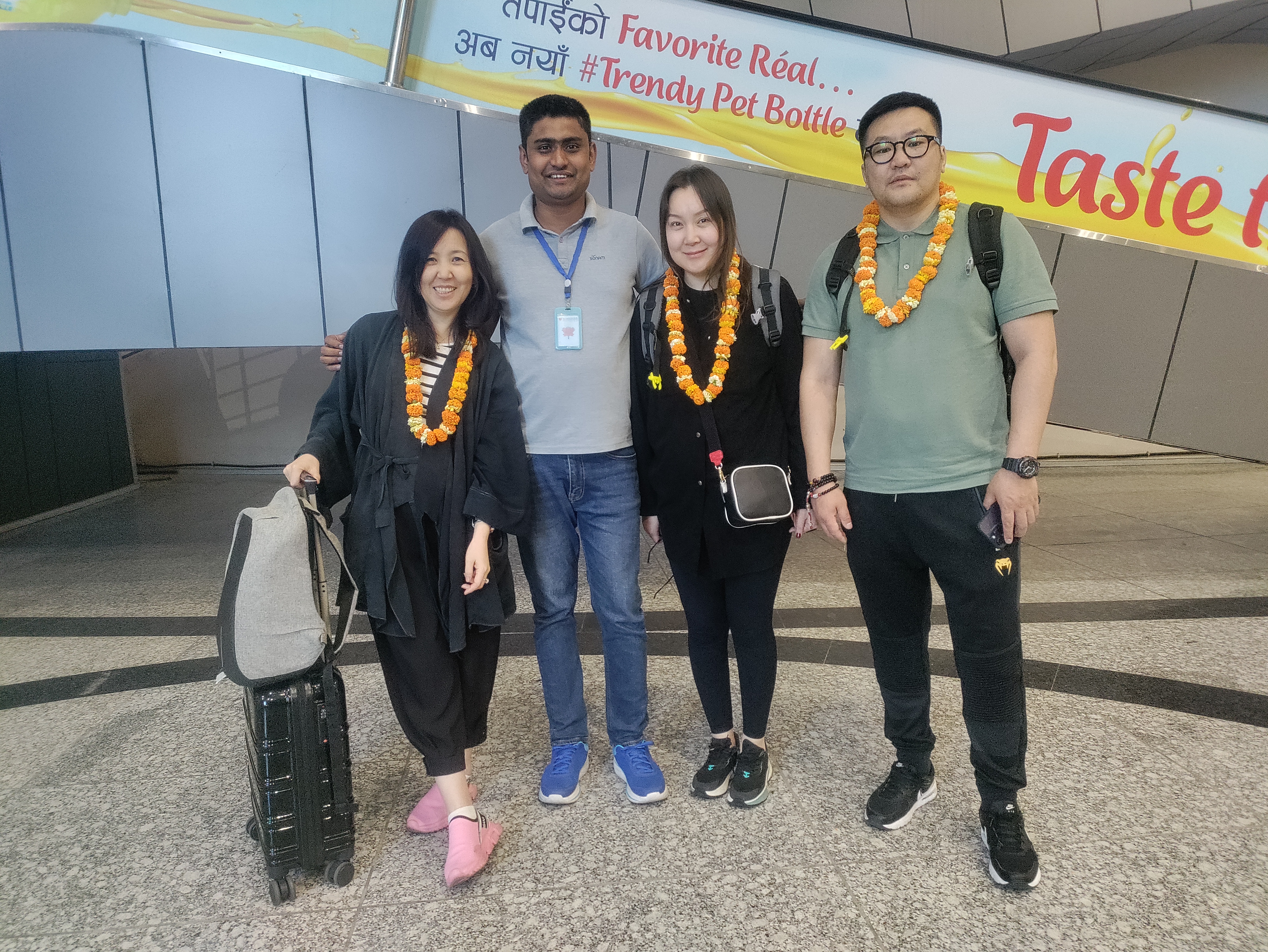
Once you arrive at Tribhuvan International Airport, our representative will welcome you and transfer you to your hotel in Kathmandu. On the way to your hotel, you will have your first impression of the city, where you will be able to notice unique Nepalese architecture, including many temples and markets located in vibrant neighborhoods. Once you check into the hotel, you can take some rest after your journey or explore the nearby streets if your flight has arrived earlier.
After dinner, you will meet your guide and other members of your trekking group and have a brief meeting regarding your trip. During this meeting, your guide will brief you about the itinerary and trail conditions. Moreover, he will explain precautions for altitude and answer all your questions. This is also an ideal opportunity for you to buy trekking gear or make sure that everything is fine with your gear. To get yourself acquainted with your future adventure, you will have a yoga class which is intended to release any travel fatigue and improve circulation and breathing. You will stay overnight in your hotel in Kathmandu.
After dinner, you will meet your guide and other members of your trekking group and have a brief meeting regarding your trip. During this meeting, your guide will brief you about the itinerary and trail conditions. Moreover, he will explain precautions for altitude and answer all your questions. This is also an ideal opportunity for you to buy trekking gear or make sure that everything is fine with your gear. To get yourself acquainted with your future adventure, you will have a yoga class which is intended to release any travel fatigue and improve circulation and breathing. You will stay overnight in your hotel in Kathmandu.
- Travel Distance: 6 to 8 kilometers (Airport Transfer)
- Travel Hours: 30 to 45 minutes
- Accommodation: 3-Star Hotel
- Meals Included: Welcome Dinner
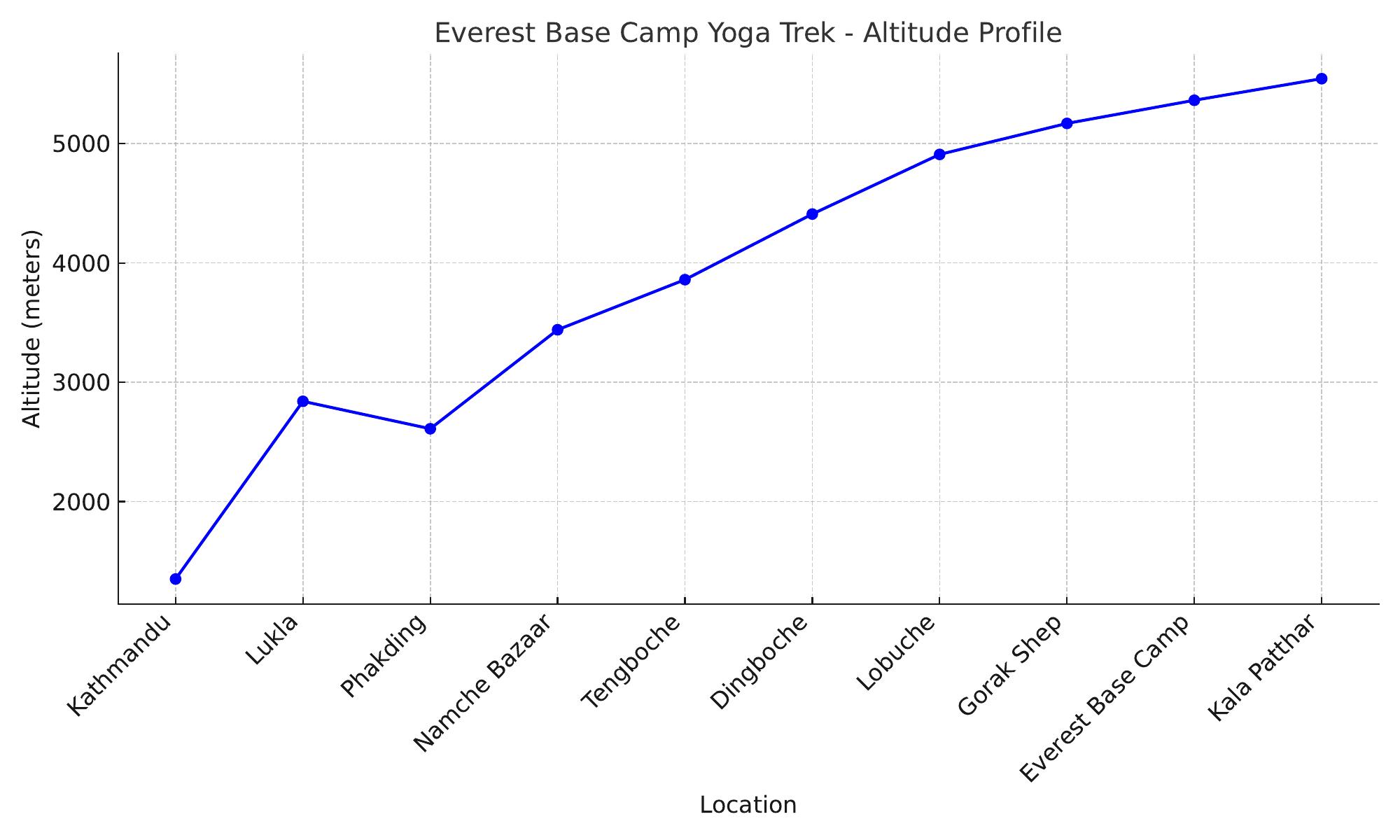
Day 2: Fly to Lukla (2,840m), Trek to Phakding (2,610m)
Day 3: Trek to Namche Bazaar (3,440m)
Day 4: Rest and Acclimatization in Namche Bazaar (3,440m)
Day 5: Trek to Tengboche (3,860m)
Day 6: Trek to Dingboche (4,410m)
Day 7: Rest and Acclimatization in Dingboche
Day 8: Trek to Lobuche (4,910m)
Day 9: Trek to Everest Base Camp (5,364m) and Return to Gorak Shep (5,170m)
Day 10: Hike to Kala Patthar (5,545m) for Sunrise and Trek to Pheriche (4,240m)
Day 11: Trek to Namche Bazaar (3,440m)
Day 12: Trek to Lukla (2,840m)
Day 13: Fly Back to Kathmandu
Day 14: Departure Day
Route Map
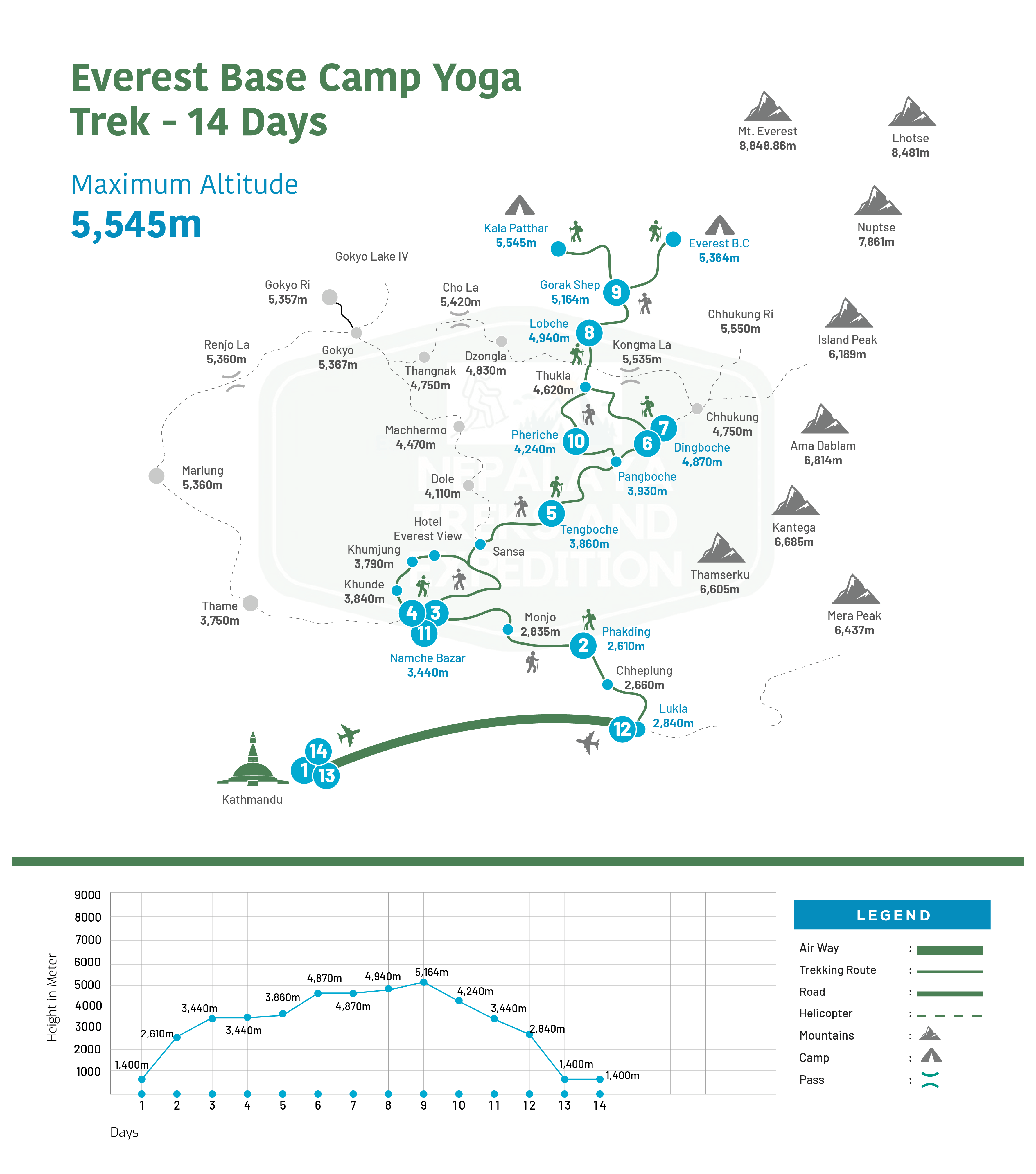
Altitude Chart
Inclusion / Exclusion
Inclusion
- Airport pickup and drop-off by private vehicle.
- Accommodation at a 3-star hotel in Kathmandu.
- Teahouse accommodation during the trekking days.
- Three meals (breakfast, lunch & dinner) during the trek.
- Welcome Dinner in Kathmandu.
- Farewell Dinner in Kathmandu.
- Flights from Kathmandu to Lukla and from Lukla to Kathmandu.
- English-speaking trekking guide experienced and licensed by the government.
- Porters' services.
- Entry Permit of Sagarmatha National Park.
- Khumbu Pasang Lhamu Rural Municipality Entrance Permit.
- Daily guided yoga, meditation, stretching & breathing classes.
- Free sleeping bag, down jacket, duffel bag, and trekking poles.
- Health check using pulse oximeter if required.
Exclusion
- International airfare to and from Nepal.
- Nepal visa fees.
- Travel insurance.
- Emergency helicopter evacuation and medical expenses.
- Trekking gear and clothing on a personal basis.
- Internet costs.
- Cost of charging batteries.
- Showers and washing clothes.
- Personal expenses such as snacks and drinks and other items that are not part of the travel itinerary.
- Tip your guides and porters.
- Any charges arising out of flight delays, flight cancellations and bad weather.
Check List
Packing the right kind of gear is essential for enjoying a comfortable journey in Everest Base Camp Yoga Trek, where you will encounter varying climate conditions as well as an altitude of 5,545 meters at Kala Patthar. Pack warm, moisture-wicking and lightweight clothing as per changes in temperature, comfortable clothing for daily yoga and meditation sessions.
Clothing
- Moisture wicking base layers
- Thermal underwear
- T-shirts
- Fleece or warm sweater
- Down jacket
- Waterproof and windproof jacket
- Waterproof trekking pants
- Comfortable trekking pants
- Comfortable yoga clothes
- Underwear
- Warm trekking socks
- Lightweight socks
- Warm gloves
- Sun hat or cap
- Warm woolen hat or beanie
- Buff or neck gaiter
Footwear
- Well broken in trekking boots with proper ankle support
- Lightweight sandals or camp shoes
- Spare shoelaces
- Gaiters
Trekking and Yoga Essentials
- 25-35 liter daypack
- Duffel bag
- Trekking poles
- Sleeping bag
- Lightweight yoga mat
- Small towel
- Headlamp with extra batteries
- Water bottles or hydration bladder
- Water purification tablets or portable filter
- Sunglasses with UV protection
- Sunscreen
- Lip balm with SPF
Personal and Health Items
- Personal medications
- Basic first aid kit
- Blister treatment and bandages
- Hand sanitizer
- Personal toiletries
- Wet wipes
- Quick drying towel
- Toilet paper and tissues
- Electrolyte or rehydration packets
- Snacks like energy bars, nuts or chocolate
Documents and Electronics
- Passport
- Nepal visa and travel documents
- Travel insurance documents
- Copies of important documents
- Mobile phone
- Camera
- Power bank
- Charging cables
- Universal travel adapter
- Extra batteries or memory cards
Optional Items
- Earplugs
- Small book or e-reader
- Dry bags or waterproof packing bags
- Zip-lock bags
- Microspikes or crampons as per recommendation on basis of trail and weather conditions
Trip FAQs
-
1. Is the Everest Base Camp Yoga Trek suitable for beginners?
Yes. The Everest Base Camp Yoga Trek is appropriate for beginners with a healthy body and ready for high-altitude trekking for several days. Despite the fact that the Everest Base Camp Yoga Trek will take you up to 5,545 meters in altitude at Kala Patthar, you won't need any technical or mountaineering experience. Our trek includes proper acclimatization, experienced guides, and yoga classes that help you feel better every day. -
2. How can I get ready for the Everest Base Camp Yoga Trek?
Prepare by walking, hiking, jogging, cycling, climbing stairs, and doing strength-training exercises for several weeks before the trek. Yoga and breathing exercises also can prepare you physically for the trek. Don't forget to wear-in your trekking boots and take proper clothes for mountains. -
3. What permits are needed for the Everest Base Camp Yoga Trek?
You will need a Sagarmatha National Park Entry Permit and Khumbu Pasang Lhamu Rural Municipality Permit for trekking in the Everest area. All permits will be taken care of by Nepalaya Treks, so you'll just enjoy your trip. -
4. Is the Everest Base Camp Yoga Trek difficult?
The Everest Base Camp Yoga Trek is moderately challenging.Most trekking days involve approximately 5–8 hours of walking, depending on the route, altitude, weather, and individual pace, through mountainous paths, suspension bridges, rocky tracks, and gradual climbs up to altitudes over 5,000 meters. Though physical health is a prerequisite for this trek, there is no need for technical skills. -
5. What is the highest point on the trek?
The highest point on the trek is Kala Patthar at 5,545 meters above sea level. From this point, you can enjoy the best panoramic view of the majestic Mount Everest with Lhotse, Nuptse, Pumori, and many more Himalayan peaks. Everest Base Camp is located at an elevation of 5,364 meters. -
6. How many hours do you walk each day?
Usually, you walk between 5 to 7 hours per day, depending on your itinerary, trek route, weather, and walking speed. On acclimatization days, the walk would be less but with yoga sessions. -
7. Do I need to have previous yoga experience?
No, previous yoga experience is not required. Sessions for yoga are designed for people of all experience levels. It includes stretching exercises, breathing techniques, relaxation, and recovery. -
8. What type of accommodation is provided in the trekking period?
In Kathmandu, you'll be accommodated in hotels. On the trail of Everest, accommodation is provided in teahouses which provide basic rooms, shared dining areas, and essential trekking facilities, which vary by location. -
9. What food items will I get during Everest Base Camp Yoga Trek?
There are many types of freshly made meals like dal bhat, fried rice, noodles, pasta, soup, potatoes, vegetables, momo, curry, and many more local and international foods that trekkers can enjoy. Breakfasts consist of porridge, eggs, toast, Tibetan bread, pancakes, muesli, tea, and coffee. -
10. Is drinking water available along the trail?
Yes, there is drinking water at the teahouses. Many trekkers prefer carrying reusable water bottles using water purification tablets or portable filters. -
11. Should I be afraid of altitude sickness?
As the trek involves heights above 5,000 meters, altitude sickness can affect you.The itinerary includes acclimatization days in Namche Bazaar and Dingboche which allows your body to get used to the heights gradually. Your guide will always check your condition and warn you if any signs occur. -
12. Is travel insurance needed?
Yes. Travel insurance that covers high-altitude trekking above 5,600 meters, helicopter evacuation in case of emergency, medical expenses, trip cancellation and delay in flights is highly recommended. -
13. When is the best time for Everest Base Camp Yoga Trek?
Spring (March to May) and autumn (September to November) are the best times for the Everest Base Camp Yoga Trek. At these times there is stable weather, visibility of mountains, favorable temperatures for trekking and perfect conditions for trekking and doing yoga on the way. -
14. What should I bring on Everest Base Camp Yoga Trek?
Bring moisture-wicking base layers, warm and insulated clothes, down jacket, waterproof outer wear, trekking boots, gloves, hat, sunglasses, sunscreen, reusable water bottles, personal toiletries, medicine, and comfortable clothes to do yoga. Nepalaya Treks provides you with the necessary trekking equipment. -
15. Is it possible to rent trekking equipment in Kathmandu?
Yes. There are several reliable companies that rent out the required trekking gear such as sleeping bags, down jackets, trekking poles, backpacks, etc. Nepalaya Treks will be glad to help you choose reliable rental companies. -
16. Will I have a guide and porter?
Yes. Every trek is led by an experienced government-licensed English-speaking trekking guide to ensure your safety, manage the itinerary, control your altitude-related health issues, provide information about the Everest region and the surrounding area. You will have porters to carry your big duffel bag so that you can easily trek with your daypack. -
17. How heavy luggage can a porter carry?
Usually, a porter can carry luggage for two trekkers weighing 20 to 25 kg. Every trekker is expected to pack 10 to 12 kg in his/her duffel bag and carry personal items in a daypack. -
18. Is Wi-Fi available during the Everest Base Camp Yoga Trek?
Yes. Many teahouses offer Wi-Fi or internet access for an additional fee, although connection quality varies. The internet speed and availability depend on the height, weather, and teahouse location. -
19. Is there provision for charging my electronic gadgets while trekking?
Yes. Most teahouses offer charging facilities for an additional fee, although availability may vary. Extra cost is applied in the upper elevations since electricity is generated through solar energy or small hydroelectric power plants. -
20. Can I customize the Everest Base Camp Yoga Trek itinerary?
Yes. You can have your own schedule for the trip depending on your preference, health, time availability, and duration. Nepalaya Treks can tailor activities, transportation, accommodation or itinerary before or after the trekking tour. -
21. How is the Everest Base Camp Yoga Trek different from the regular one?
The Everest Base Camp Yoga Trek follows the classic Everest Base Camp trekking route while incorporating daily yoga, meditation, stretching, and breathing sessions. In addition to enjoying the beauty of Himalayas, Sherpa culture, and trekking trails, you will get time exclusively for yoga, relaxation, breathing and wellness sessions.
Overview

Everest Base Camp Yoga Trek – A Truly Life-Changing Experience!
Denmark
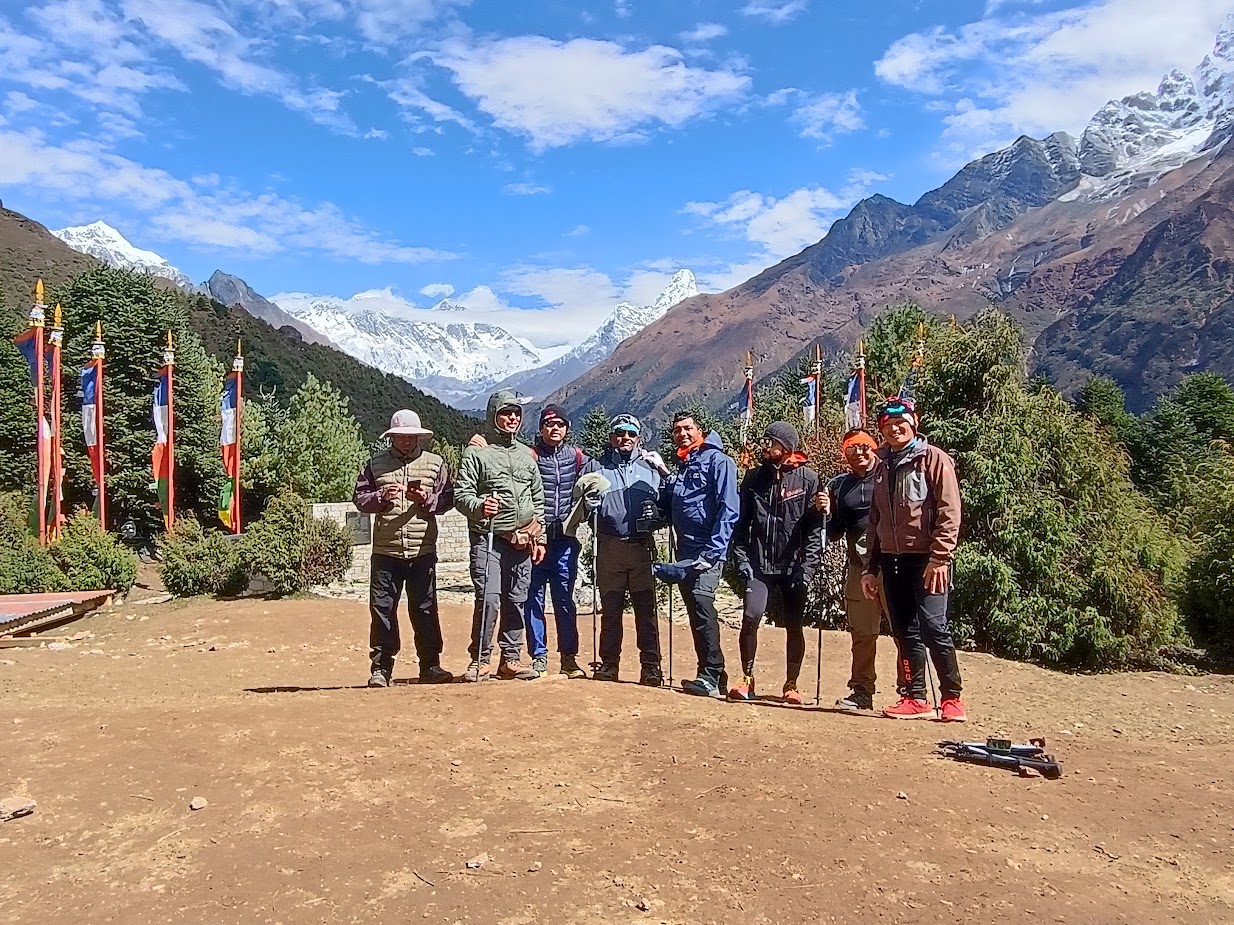
I recently completed the Everest Base Camp Yoga Trek with Nepalaya Treks and Expedition, along with 7 of my friends, and I can honestly say it was one of the most unforgettable experiences of my life!
From start to finish, everything was perfectly organized. Our yoga teacher Aimi and her team were absolutely amazing—so warm, friendly, and supportive throughout the journey. Practicing yoga in the serene Himalayan landscape was beyond magical. It added a whole new dimension of peace and mindfulness to the trek.
A huge shoutout to our guide Ram, whose knowledge of the region, culture, and the mountains was truly impressive. He took care of every little detail and made us feel safe and well-informed at every step. His calm energy and experience made the trek smooth and enjoyable for all of us.
The entire Nepalaya team went above and beyond to make this trip perfect. We felt cared for, inspired, and constantly encouraged. I highly recommend Nepalaya Treks and Expedition to anyone looking for a genuine, spiritual, and well-managed Himalayan adventure.
Namaste and thank you! 🙏

Unforgettable Everest Base Camp Yoga Trek with Nepalaya Treks!
United States
I recently completed the Everest Base Camp Yoga Trek with Nepalaya Treks and Expedition, and it was truly the experience of a lifetime. Our group of 12 people had the most amazing time—everything was perfectly organized and beyond our expectations.
Our yoga teacher Aimi and her team were incredibly friendly, supportive, and kind. Practicing yoga in the heart of the Himalayas was surreal—every session felt deeply spiritual and connected us with the breathtaking nature around us.
Special thanks to our amazing guide Lakpa, whose knowledge, patience, and leadership made our journey smooth, safe, and unforgettable. He took care of every little detail and always made sure we were comfortable and motivated.
The combination of trekking to Everest Base Camp and daily yoga sessions created a perfect balance of challenge, peace, and reflection. It was more than just a trek—it was a journey of personal growth, teamwork, and deep connection.
Thank you to Nepalaya Treks and Expedition for such an incredible experience. I highly recommend them to anyone looking for an authentic and mindful Himalayan adventure.
Incredible Everest Base Camp Yoga Trek with Nepalaya Treks!
Singapore
Our group of 5 friends just completed the Everest Base Camp Yoga Trek with Nepalaya Treks and Expedition, and it was truly one of the most amazing experiences of our lives!
From the beginning, everything was perfectly arranged. A huge thank you to our wonderful yoga teacher Aimi—she brought so much positive energy, calmness, and inspiration to our journey. Practicing yoga every day in the middle of the Himalayas was an unforgettable experience.
Our guide Krishna was incredibly knowledgeable, supportive, and always ready to help. We felt safe and well taken care of throughout the trek. Our porter Laxman also deserves special mention—he was so friendly, hardworking, and full of good spirit!
We also really appreciate Kamal, the owner of the company, who gave us a very good price and made sure everything ran smoothly from start to finish. His communication and organization were excellent.
The combination of trekking, yoga, and the stunning mountain views made this journey truly special. We couldn’t have asked for a better team or experience.
Highly recommend Nepalaya Treks and Expedition to anyone looking for a spiritual, adventurous, and well-organized Himalayan journey.
Video
All Inclusive Cost
USD 1595
Per Person
BOOK NOW QUICK ENQUIRY- Best Price Guarantee
- Hassle-Free Booking
- Team of highly experienced Experts
You may also like !!
Our Best Selling Packages You May Like.